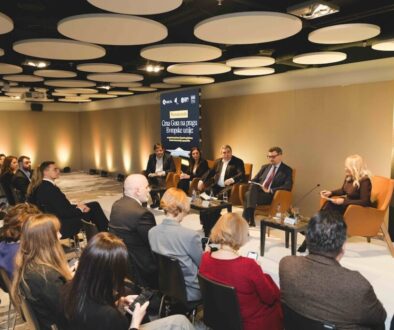
The victory of the Student List in Serbia is a victory over a regime that stifled freedoms, set the country at odds with its neighbours and was deeply embroiled in criminal activity. This victory offers hope for regional reconciliation, but also calls for caution, as past experience has taught us. This was the message from the third working session of the regional conference PLENUM 2026, organised by the Regional Academy for Democratic Development (ADD) and the Centre for Civic Education (CCE) together with the Faculty of Political Sciences at the University of Sarajevo and the European Fund for the Balkans (EFB).

During the panel “Stability in the Region: How Much Safer Is the Region After the Elections in Serbia and Bosnia and Herzegovina?”, journalist Adnan Rondić spoke with Saša Magazinović, a member of the Parliamentary Assembly of Bosnia and Herzegovina; Dr Nemanja Batrićević, a teaching associate at the Faculty of Political Sciences at the University of Montenegro; and Nada Kolundžija, a former member of the National Assembly of the Republic of Serbia.
“The regime we had was not just one that stifled freedoms. It was a regime that sowed hatred and set the country at odds with anyone it could, especially its neighbours. It was a regime deeply embroiled in criminal activity. Every country has a mafia, but Serbia had the mafia in power,” Nada Kolundžija said, noting that the difficult task of defending freedom lay ahead following the Student Movement’s victory.
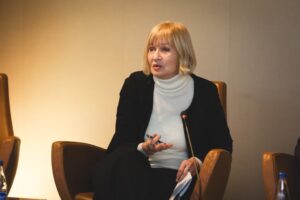
Batrićević described the changes in Serbia as a positive step. “However, from Montenegro’s perspective, it is still too early to celebrate or draw conclusions about their long-term effects. My impression is that in Montenegro, the intensity of political processes changes more often than their substance. We have seen this film before, and there have been times when liberal forces in Serbia gained prominence,” Batrićević said.

Speaking about the potential impact of changes in Serbia on Montenegro, he noted that internal political conflicts and power struggles could turn Serbian political actors’ attention towards domestic issues, leaving less room for the kind of influence they had previously exerted on Montenegro. “Vučić built an unusual combination of political power, media control and ties to criminal networks, which also left Montenegro exposed to his actions. The new authorities will not have the same resources at their disposal, even if they have similar intentions, and I think that is an important factor,” Batrićević stated.
However, he warned that a change of government alone can only achieve so much and would not necessarily bring a substantive change in Serbia’s political approach towards Montenegro. “From Montenegro’s perspective, that approach has always been the same. Perhaps I view developments in Serbia too much from our own perspective, but historical experience and trauma give rise to a degree of scepticism. This does not, however, mean that I am sceptical about the long-term effects of the current changes,” Batrićević explained.
“At the polls, Serbian citizens clearly showed what they were voting against, but it is still not entirely clear what political alternative they supported. We know for certain that people voted against Vučić, his arrogance and his regime, which was so steeped in criminality that crime had effectively become normalised,” Saša Magazinović said, adding that Milorad Dodik, as a close ally of Vučić, had also helped mobilise voters, particularly young people. He believes that some older citizens who would otherwise have supported Vučić also contributed to his defeat by staying away from the polls.
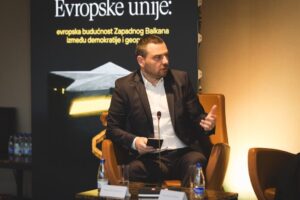
Reflecting on the relationship between Vučić and Dodik, he said that their political alliance had effectively ended on election night, when Dodik began establishing contact with the election winners. He recalled that Dodik had changed political allies in Serbia before, citing Boris Tadić as an example. “Dodik is first and foremost a dealmaker, with a finely honed instinct for political survival. When his room for manoeuvre narrows, he responds by attacking even more aggressively,” Magazinović said. He believes that Dodik’s current demands are unattainable, but that his electoral support must not be ignored, adding that his result would have been considerably worse had the elections in Serbia preceded those in Bosnia and Herzegovina.
Kolundžija stressed that reconciliation and peace in the region cannot be achieved overnight, but was confident that if Serbia remains stable through the transfer of power, it will adopt an entirely different approach towards its neighbours, the region and European values. “Serbia’s approach towards Bosnia and Herzegovina and Montenegro was not based on Serbia’s genuine interests. Neither Milošević’s nor Vučić’s government based that approach on Serbia’s interests, but instead used it as a means of holding on to power. There was massive plunder under each of those nationalist governments. That is why they needed an enemy within Serbia, while Montenegro, Bosnia and Croatia were also cast as enemies,” she said.
Kolundžija said that she understood the caution of countries in the region, but also believed that the pressure should be eased somewhat. “Even if some of the rhetoric echoes the past, we should not seize on it. Any pressure to take a clear position on divisive issues could reverse the process. Most citizens in Serbia do not see Montenegrins, Bosnians or Croats as enemies, but the indoctrination they are exposed to creates fear. Overcoming that fear will also allow relations in the region to develop freely,” Kolundžija stated.
Batrićević recalled that identity issues in Serbia are deeply intertwined with national myths and patterns of political behaviour that extend beyond individual governments and their terms in office. “I am aware that crime is deeply entrenched in Serbian society, but I would set the priorities differently, because I do not see the fight against corruption as the most important issue. One side still refuses to recognise the sovereignty of others. If the most Serbia can offer on Montenegro is to say that we should leave the issue for later, then the mistrust is understandable,” Batrićević said.
Speaking about the future of regional relations, Magazinović stressed that he did not expect the new government in Serbia to immediately recognise the genocide in Srebrenica. “A step forward would be to stop downplaying war crimes and the responsibility of war criminals, so that we can see whether a new policy is truly taking shape – one that will not threaten neighbouring countries. And going forward, it would be important to stop retraumatising one another,” Magazinović concluded.