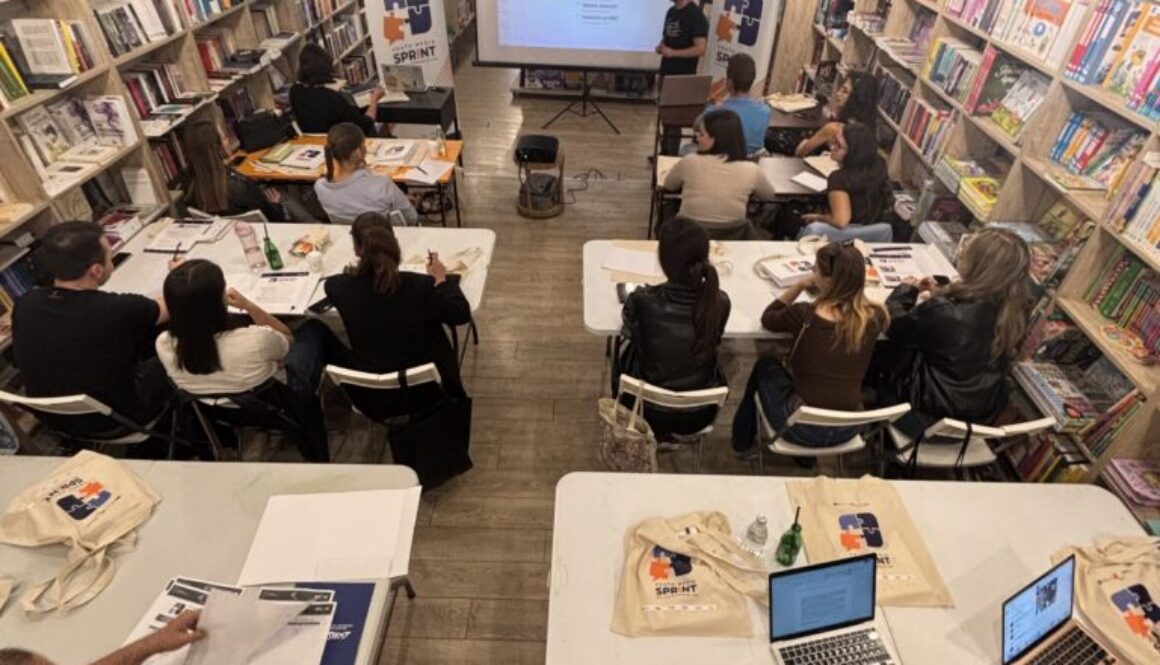
We invite you to apply for the POLITEIA Thematic Session "Public Policies for WB Youth Housing Independence", which will take place on 22–23 December 2025 in Belgrade (Hotel Palace, Toplicin venac 23), organized by the Regional Academy for Democratic Development (ADD).
The aim of this session is to strengthen the capacities of young people, civil society organizations, and decision-makers to better understand and analyze public policies addressing housing independence for youth in the Western Balkans. Participants will gain an in-depth understanding of the structure of housing policies, the process of defining objectives and measures, legal frameworks, and methods for assessing the social impact of policies — particularly on young people and other vulnerable groups. The session will also focus on alignment with EU standards and the exchange of policy practices from other Western Balkan economies and EU Member States. This activity will further support regional cooperation and a joint understanding of the key challenges in improving access to housing for young people.
The POLITEIA thematic session also includes a one-day mentoring program, during which participants will further enhance their practical skills in analyzing and preparing policy proposal documents within this field. Participation is open to youth organization representatives, young activists, young members of political parties, as well as decision-makers from Albania, Bosnia and Herzegovina, Kosovo*, Montenegro, North Macedonia, and Serbia. Applications must be submitted in English, which is the working language of the session.
Travel, accommodation, and meals will be fully covered by the organizer — the Regional Academy for Democratic Development.
The project Regional Youth Dialogue for Europe is implemented by the Center for Democracy Foundation, Belgrade (as project coordinator), in partnership with: Academy for European Integration and Negotiations, Tirana (AIEN); Kosovar Stability Initiative, Pristina (IKS); Network for Progressive Initiatives, Sarajevo (NPI); NGO Info Center, Skopje (NGO IC); Regional Academy for Democratic Development, Novi Sad (ADD); and Youth Act Center, Tirana (YA). The project is funded by the European Union.
The Academy for the Development of Democracy (ADD) organized a Regional Policy Lab dedicated to culture and youth participation, within the framework of the Regional Youth Dialogue for Europe (RYDE) project funded by the European Union. The event brought together more than forty representatives of institutions, youth organizations, cultural institutions, experts, activists, and young people from Serbia, Albania, Bosnia and Herzegovina, Kosovo, North Macedonia, and Montenegro. It marked one of the most inclusive regional gatherings to date focused on strengthening the role of young people in shaping cultural policies across the Western Balkans.
Over the past several months, each economy in the region developed its own national set of recommendations on culture and youth participation through national policy labs. This regional meeting served as a platform to compare those findings, identify shared priorities, and begin forming a unified regional approach that can serve as a foundation for future cooperation. Participants exchanged insights on legislative frameworks, the functioning of cultural institutions, youth cultural funding, access to EU programmes, and mechanisms for including young people in local cultural policymaking. One of the most inspiring discussions centered on the need to introduce the European concept of “triple transformation” – green, digital, and social – into cultural policies, ensuring that young people are supported to lead innovation in sustainability, digital culture, and social inclusion. This approach was recognized as both innovative and highly transferable across the region.
Discussions revealed that the Western Balkan economies share almost identical challenges: young people rarely participate in decision-making; cultural policies remain fragmented; funding is unstable; and access to European cultural and mobility programmes is insufficiently supported through national mechanisms. For this reason, a regional, collaborative approach is not only desirable but essential for building modern cultural policies that recognize young people as creators and drivers of cultural life, rather than merely its consumers.
Participants agreed on several common principles that will form the basis of the forthcoming regional set of recommendations. These include strengthening youth participation in cultural institutions and advisory bodies, aligning cultural and youth strategies, increasing public investment in culture, creating predictable financial mechanisms for youth and independent culture, improving access to cultural life for vulnerable groups, and harmonizing national legislation with ratified European and international conventions. The need for a strategic framework that enhances youth participation in EU cultural programmes was also strongly emphasized.
The atmosphere of the Regional Policy Lab was collaborative, open, and creative. Young participants shared experiences from their local communities, challenges they face in cultural production, and ideas for strengthening regional connectivity. Their contributions provided clear guidance for the development of the regional recommendation document, which will be finalized in the coming period and presented to decision-makers and international partners.
The Regional Policy Lab reaffirmed that the European Union, as the funder of the project, recognizes the importance of youth participation in policymaking and the value of cultural cooperation as a space for democratic development, innovation, and dialogue. ADD and its partners will continue consultations and finalize the regional recommendation framework, which will serve as a shared platform for advancing cultural policies and empowering young people across all Western Balkan economies.
One regional conference – five cities – one vision: Belgrade · Sarajevo · Skopje · Tirana · Pristina
ChatGPT said:
The Regional Academy for Democratic Development, in cooperation with partner organizations from across the Western Balkans, organized a two-day regional conference “Western Balkan Youth and the European Union: Shaping Our Common Future” within the project “Regional Youth Dialogue for Europe – RYDE” (2023–2026), supported by the European Union.
The event was held on 18 and 19 November 2025, simultaneously connecting voices from five cities – Belgrade, Sarajevo, Tirana, Skopje, and Pristina – in a regional gathering featuring inspiring speakers, dynamic panel discussions, and youth-led initiatives.
At the opening of the conference, Plamena Halacheva, Deputy Head of the Delegation of the European Union to Serbia, emphasized that the EU recognizes the many challenges young people face — from economic insecurity and social inequalities to the growing impact of climate change. Halacheva underlined that dialogue is the space where progress begins, noting that young people should come together and remain open, honest, and curious to learn from one another.
Secretary General of the Center for Democracy Foundation, Nataša Vučković, emphasized that young people must be recognized as drivers of change, noting that they carry European values in their expectations—and today, more than ever, they advocate for those values clearly and courageously. The Western Balkans are part of Europe, she stated, and will become even more so through deeper democracy, strengthened rule of law, and the protection of human rights.
Brankica Janković, Commissioner for the Protection of Equality of the Republic of Serbia, stated in her video address that young people must dream bigger dreams than those offered to them, observing that they understand that economic security, the rule of law, and the elimination of corruption are essential priorities.
The regional conference brought together young people, policymakers, civil society representatives, experts, and other stakeholders from across the Western Balkans to present youth priorities and challenges in the EU integration process, to encourage mutual understanding, and to highlight examples of good practice from the Western Balkans and the European Union. Discussions focused on public policies, advancing reforms, and shaping a shared European future.
The aim of the conference was to strengthen the voice of young people at the local, national, regional, and European levels, promoting dialogue on reforms that directly impact the young generation.
Key topics were explored through five panel discussions: • A Bridge to Europe – Western Balkan Youth in Reform Processes • Youth Employment in the Age of Artificial Intelligence: The Youth Guarantee in the Western Balkans – Challenges and Opportunities • Youth Wellbeing in Focus: Health, Housing, Culture • Youth in the Digital Landscape: Safety, Trust, and Resilience • Youth and Nature: A Partnership for a Sustainable Green Future
The conference was implemented within the project “Regional Youth Dialogue for Europe – RYDE” (2023–2026), supported by the European Union and carried out by the Center for Democracy Foundation in cooperation with partner organizations from across the Western Balkans.
The instrumentalization of national and religious identities—presented as the only valid markers of belonging—is increasingly deepening social divisions. This approach, which automatically places “others” in a subordinate position, was one of the key topics of the PROUDCAST produced by the Centre for Civic Education (CCE).
Željka Zvicer, Programme Associate at the CCE, discussed the rise of hate speech and xenophobia, as well as their roots in the Western Balkans, with Ervina Dabižinović, Coordinator at the Centre for Women’s and Peace Education ANIMA (Montenegro); Adnan Rondić, journalist from Bosnia and Herzegovina; and Balša Božović, Executive Director of the Regional Academy for Democratic Development (ADD), Serbia.
One of the triggers for the discussion was the recent violent incident and the wave of hate speech that followed the attack on a young man in Podgorica, which was initially attributed to Turkish nationals.
Journalist Adnan Rondić was not surprised by Prime Minister Milojko Spajić’s reaction after the incident, which led to the abrupt abolition of visas for Turkish citizens.
“Some may call it impulsive, but I am not sure he would have reacted in the same way had the initial information—although it later proved false regarding Turkish nationals—spoken of some other nationality. I think he was trying to gauge the pulse of Montenegrin society, and I fear he assessed it correctly. That is why he came out with a political decision to abolish visas for Turkish citizens because of an event in which they, as we now know, did not participate. And that opened a series of situations and events in which we heard what, unfortunately, has been heard in this region for centuries,” Rondić observed.
Ervina Dabižinović believes that the atmosphere of intolerance is also a consequence of the region’s failure to confront the legacy of the 1990s. “After the 1990s, people no longer lived together. So it is not surprising that what happened a few days ago occurred. It was well prepared and drawn from a very vivid memory. Where did these so-called patriotic patrols come from, and how did they suddenly appear on the streets? You see people with balaclavas and bats being escorted and neatly protected by the police. You have state institutions involved in a single fist and a single act of persecution,” Dabižinović stressed.
She added that these are well-known lessons that should have been learned long ago, but are still used today as a convenient political tool.
“We constantly have a problem with ‘the others’—and we are not resolving it. And where attempts were made, it took 30 years to build something very fragile, something that was completely defeated in those days. And I myself was defeated. Defeated in my attempt to explain that hatred is directed at the person next to us, not at someone imaginary, but at the person right beside us. The face of the enemy is not unknown. But we have not established responsibility for what happened, so we will see repetition—1995–2025,” she warned.
Balša Božović argued that the statement of the President of Serbia, Aleksandar Vučić, about the “revival of the Ottoman Empire” following the delivery of Turkish drones to Kosovo, was not accidental.
“You are now in a position to consolidate your national interest and lead Montenegro into the European Union. On that path, you will face situations like the one with the Turkish citizens, with the hysteria that was stirred up, with false statements, with ready-made fan groups, with orchestrated slogans… these are all textbook examples of attempts to destabilize the path or policies that Montenegro has taken—not in 2020, because that was merely inertia. In fact, 2020 tried to break that. Whether it will succeed, we will see. But in the next two or three years, you will have a hyper-production of such situations. I do not know whether you will manage to free yourselves from that or whether you will withstand this period,” Božović cautioned.
Reflecting on the multicultural and multinational character of Montenegrin society, Ervina Dabižinović said that these qualities today remain largely declarative, while “the underlying cultural matrix and cultural pattern are being fundamentally eroded and reshaped.” She recalled the polarization that has persisted since the restoration of independence. “Since 2006, we have had two camps: those who never accepted it, and those who believed that, on this new wave, they would finally do everything right. But we did not start from zero; there was no lustration, no confrontation with the past, not a single element of transitional justice was implemented in this society,” Dabižinović explained.
Božović also spoke about the manipulation of the concept of reconciliation. “Their devilish work functions that way; they came up with this idea that we should all ‘reconcile,’ but they are not the first fascists to do it. Franco had a policy of mixing the bones of executioners and victims; Tuđman did the same. It does not matter—let the one who was shooting and the one who was shot be placed together. Then Mandić said, in a debate with Đukanović during the election campaign, that they had already reconciled, that the bones had already reconciled. What is reconciliation for them? That Mladić and the Mothers of Srebrenica should reconcile? And then they say, ‘So, you are against reconciliation?’” he noted.
Adnan Rondić also emphasized that such discourse requires a clear distinction between guilt in the legal sense, which cannot be collective, and collective responsibility, which is an ethical category. “The genocide in Srebrenica— I always insist that it was committed by individuals, but by a very large number of individuals, considering that it had to be planned, prepared, executed, then the traces had to be removed, and then the genocide had to be denied… All of this happened in front of someone’s eyes. If you remain silent, while seeing what is happening, hearing what is happening, knowing what is happening — then you bear that type of responsibility,” he stressed.
Božović argued that insisting on collective guilt is used to justify violence. “In Kosovo, in the ‘Panda’ café in Peć, a special operations unit — mixed with what were then the young members of the Zemun Clan — carried out a massacre of Serbian children in order to prepare a narrative for the international community against the mujahideen from Kosovo, against Al-Qaeda, and whatever else… And to collectively attach a label: you are all terrorists, murderers, which means the police now has justification to level you to the ground. In that sense, it is a way to justify violence and killings — they have no hesitation in sacrificing as many as needed,” Božović explained.
The speakers agreed that Montenegrin society, as well as societies across the region, will have to broaden the circle of dialogue—but on clear and principled grounds—in order to overcome intolerance and curb hate speech.
“Let us count the damage we have suffered — one side, the other side, the third, the fifth. Is it worth it? We can talk about who started it, about the ideologies that initiated and continue this story, but no one emerged unscathed. We speak mostly about the Serbian political elites, and accordingly about the Serbian people. As much as we have talked about the ‘Serbian world,’ let us now consider all the places where Serbs are no longer present today. Primarily due to Serbian politics — from Croatia, to large parts of Bosnia and Herzegovina; even the Republika Srpska is empty. The eastern part especially — there are no people, no Serbs, no Bosniaks, no one; that area is simply empty. It was ethnically cleansed, people did not return in sufficient numbers, and many Serbs left. So, it is desolate — and what are we actually talking about? Our land is empty,” Rondić concluded.
This PROUDCAST was produced within the framework of the REGIONAL PLENUM 2025 – Fractures in Democracy: Nationalism and Clericalism in the Western Balkans, organized by the Academy for the Development of Democracy (ADD), the Centre for Civic Education (CCE), the Faculty of Political Sciences of the University of Sarajevo, and the German Friedrich Ebert Foundation (FES). The content of the episode is the sole responsibility of the speakers.
One regional conference – five cities – one vision: Belgrade · Sarajevo · Skopje · Tirana · Pristina
The Center for Democracy Foundation, in cooperation with partner organizations from the Western Balkans, is organizing the two-day regional conference „Western Balkan Youth and the European Union: Shaping Our Common Future“ on Tuesday and Wednesday, November 18 and 19, 2025.
The conference will take place at Prostor Miljenko Dereta, Dobračina 55, Belgrade, with simultaneous participation of speakers from studios in Sarajevo, Tirana, Skopje, and Pristina.
BELGRADE – Prostor Miljenko Dereta, Dobračina 55, Belgrade
SARAJEVO – Hotel Ibis Styles, Dzemala Bijedica 169A, Sarajevo
PRISTINA – Hotel Sirius, Agim Ramadani, Pristina 1000
TIRANA – Xheko Imperial Luxury Hotel & Spa, Rruga Ibrahim Rugova Nr.56/H2, Tirana
SKOPJE – Hotel Solun, ul. Nikola Vapcarov 10, Skopje
Zoom link: Topic: Western Balkan Youth and EU: Shaping our Common Future Join Zoom Meeting https://us02web.zoom.us/j/86795198765 Meeting ID: 867 9519 8765
The aim of the conference is to provide an opportunity for young people, civil society organizations, decision-makers, experts, and other stakeholders from the Western Balkans to present the priorities and challenges faced by young people in the process of European integration. It seeks to encourage mutual understanding and highlight good practices from both the Western Balkans and the European Union.
The conference aims to strengthen the youth voices at the local, national, regional, and European levels, fostering dialogue on reforms that affect the young generation.
The two-day conference will feature the following five panels:
I Bridge to Europe: Western Balkans Youth in Reform Processes
II Youth Employment in AI Era: Youth Guarantee in the Western Balkans – Challenges and Opportunities?
III Youth Well-being in Focus: Health, Housing, Culture
IV Youth in the Digital Landscape: Security, Trust and Resilience
V Youth and Nature: A Partnership for a Sustainable Green Future
The conference is organized within the project “Regional Youth Dialogue for Europe” (2023–2026), supported by the European Union and implemented by the Center for Democracy Foundation in cooperation with partner organizations from the Western Balkans.
The fifth panel of the Cetinje Forum – FORCE2025 was titled “The Current Situation in Serbia and Reflections on the Western Balkans”.
Speaking on the fifth panel, the Executive Director of the Regional Academy for Democratic Development from Novi Sad, Balša Božović, said that there is nothing European left in Serbia in the past 13 years.
“Serbia has never been closer to Russia, and in the Report it is mentioned in the context of Georgia. The rapprochement is evident. This is the worst report Serbia has ever received,” Božović stated.
He emphasised that as long as such a regime is in power, it will continue trying to destabilise the region.
“For Greater-Serbian politics to survive, it will push the region away from the European Union (EU). That is why Montenegro’s path to the EU is not important only for Montenegro, but for the entire region. Montenegro will face many obstacles on that path,” Božović underlined.
To prevent this, he argued, Serbia needs democratisation, meaning at least 33 percent of citizens who support the EU.
“It is important for society in Serbia to understand how crucial Montenegro’s accession to the EU is for them as well,” Božović added.
He concluded that Vučić’s foreign policy has suffered a “total collapse,” and that he will try to do anything in order to survive politically.
Senior Research Fellow at the Institute for Philosophy and Social Theory of the University of Belgrade, Milivoj Bešlin, noted that “no one can escape from their own history.”
“After Vučić, we will have no guarantees that society has learned all its lessons. We will see what our society will look like and whether it will move towards a genuine democratisation,” Bešlin said.
Professor at the Faculty of Philosophy at the University of Novi Sad, Aleksej Kišjuhas, said that every form of free, democratic movement must be supported.
Professor at the Department of Media Studies of the Faculty of Philosophy at the University of Novi Sad, Dinko Gruhonjić, stated that Serbian society has been poisoned, because there are people for whom it is normal to chant “Aco, you Albanian!”
“The situation is very dangerous. Imagine the kind of mental mush in the minds of people who have been watching this for 40 years, on all Serbian television channels. The regime is in terrible paranoia, in incredible fear,” Gruhonjić said.
The panel was moderated by political scientist Emir Pilav.
Cetinje will host the Cetinje Forum – FORCE2025 on 14 and 15 November, an international conference entitled “Shaping Disorder: Democracy, Security and Leadership in an Age of Global Transformation”, which will bring together prominent intellectuals, politicians, diplomats, journalists and activists from Montenegro, the region and the world.
The Forum is organised by the Faculty of Montenegrin Language and Literature, the Old Royal Capital Cetinje and the international network WestBalkanNet (WBN), with the support of the Faculty of Political Science of the University of Sarajevo, the Regional Academy for Democratic Development from Novi Sad, the Montenegrin PEN Centre and the Cultural Centre of the Old Royal Capital Cetinje.
Launched in 2022, the Cetinje Forum has established itself as a regional platform for dialogue on democracy, human rights, peace and European integration. This year’s edition is dedicated to reflecting on global turmoil and the ways in which states, societies and institutions can preserve liberal-democratic values in a world marked by crises, propaganda and the rise of authoritarian tendencies.
The programme of the Forum includes ten panels and thematic sessions featuring more than forty participants from Montenegro, the region, the European Union, the United Kingdom and the United States.
Among them are: Vesna Pusić, Minister of Foreign and European Affairs of the Republic of Croatia (2011–2016); Iveta Radičová, Prime Minister of the Slovak Republic (2010–2012); Peter Galbraith, United States Ambassador to Croatia (1993–1998) and United Nations Assistant Secretary-General in 2009; Gordana Đurović, Deputy Prime Minister of Montenegro (2004–2010); Tinatin Khidasheli, Minister of Defence of Georgia (2015–2016); František Lipka, former Ambassador of Slovakia and Chair of Montenegro’s Republican Referendum Commission in 2006; Roman Jakič, Minister of Defence of Slovenia (2012–2014); Jakub Klepal, Executive Director of the Forum 2000 Foundation in Prague; as well as numerous university professors, journalists and representatives of the civil sector.
The special guest of the Forum will be Edita Hrdá, Envoy of the Government of the Czech Republic for the Western Balkans, who will speak about the enlargement of the European Union.
“The panels will focus on topics such as: the European Union enlargement process and the position of Montenegro, diplomacy in times of crisis, challenges to democracy and human rights, media freedom and the fight against disinformation, the active engagement of youth in shaping new democratic policies, as well as the current situation in Serbia and its reflection on the Western Balkans,” the organisers state.
Particular attention will be devoted to the promotion of the document “Montenegro: Non-paper”, and the Forum will also feature the presentation of the book “Sick from the Past” by historian Adnan Prekić.
“The goal of the Forum is to affirm Montenegro and Cetinje as a space of open dialogue and European reflection on the future of democracy, security and regional cooperation. In a time of growing global uncertainty, the Cetinje Forum aims to offer a space for the exchange of ideas and the building of bridges between academia, politics and civil society,” the organisers note.
The organisers invite media representatives to follow the work of the Forum, whose sessions will take place in the Government House in Cetinje. Registration of participants and journalist accreditation will be open on Friday, 14 November, from 9:00.
Forum Programme:
FIRST DAY – 14 November 2025
PANEL 1 (09:45 – 10:45)
The EU Enlargement Process and Geopolitics: Presentation of the Document “Montenegro: Non-paper”
Speakers:
Vesna Pusić, Minister of Foreign and European Affairs of the Republic of Croatia 2011–2016
Iveta Radičová, Prime Minister of the Slovak Republic 2010–2012; Minister of Defence of the Slovak Republic 2011–2012; Dean of the Pan-European University, Bratislava
Peter Galbraith, United States Ambassador to Croatia 1993–1998; United Nations Assistant Secretary-General 2009; Senator of the State of Vermont, Windham District 2011–2015
Gordana Đurović, Minister of European Integration and Deputy Prime Minister of Montenegro (2004–2010); Full Professor, Faculty of Economics, University of Montenegro
Moderator: Marko Banović, analyst at the Digital Forensic Center
PANEL 2 (11:00 – 11:45)
Diplomacy in Times of Crisis
Speakers:
H.E. Matei-Viorel Ardeleanu, Ambassador of Romania to Montenegro
H.E. Veselko Grubišić, Ambassador of the Republic of Croatia to Montenegro
H.E. Janina Hřebíčková, Ambassador of the Czech Republic to Montenegro
H.E. Oleh Herasymenko, Ambassador of Ukraine to Montenegro
Moderator: Marko Savić, political scientist
11:45 – 12:00 Break
12:00 – 12:30
European Union Enlargement: Reality or Illusion?
Speaker: H.E. Edita Hrdá, Envoy of the Government of the Czech Republic for the Western Balkans Moderator: Olivera Komar, Professor at the Faculty of Political Science, University of Montenegro
PANEL 3 (12:45 – 13:45)
Challenges to Democracy, Human Rights Policy and Security in Central and Southeast Europe
Speakers:
Jakub Klepal, Executive Director, Forum 2000 Foundation, Prague
Roman Jakič, Honorary President of the liberal network LIBSEEN; Minister of Defence of Slovenia 2012–2014; Member of the European Parliament 2000–2004
Daliborka Uljarević, Executive Director, Centre for Civic Education (CGO)
Elira Luli, Lecturer and Researcher in International Relations, “Luarasi” University, Tirana
Sead Turčalo, Dean of the Faculty of Political Science, University of Sarajevo
Moderator: František Šístek, Institute of History of the Czech Academy of Sciences
PANEL 4 (14:00 – 15:00)
The Importance of Media Freedom in the Contemporary World
Speakers:
Darko Šuković, Editor-in-Chief, Antena M
Draško Đuranović, Editor-in-Chief, Television E
Jasmina Muminović, Editor-in-Chief, Standard portal
Danica Nikolić, Editor-in-Chief, M portal
Darko Ivanović, Executive Director, NGO “35mm”
PANEL 5 (17:15 – 18:15)
The Current Situation in Serbia and Its Reflections on the Western Balkans
Speakers:
Balša Božović, Executive Director, Regional Academy for Democratic Development, Novi Sad
Milivoj Bešlin, Senior Research Fellow, Institute for Philosophy and Social Theory, University of Belgrade
Aleksej Kišjuhas, Professor, Faculty of Philosophy, University of Novi Sad
Dinko Gruhonjić, Professor, Department of Media Studies, Faculty of Philosophy, University of Novi Sad
Moderator: Emir Pilav, political scientist
18:30 – 19:30
Promotion of Adnan Prekić’s Book “Sick from the Past” (Publisher: Analitika)
SECOND DAY – 15 November 2025
PANEL 1 (09:30 – 10:30)
The Importance of EU Integration in Protecting Democratic Values from Authoritarianism
Speakers:
Tinatin Khidasheli, Minister of Defence of Georgia 2015–2016; President of Civic IDEA
František Lipka, former Ambassador of Czechoslovakia to the former Yugoslavia; former Ambassador of Slovakia to France, UNESCO, Belgium, Luxembourg and Montenegro; Chair of the Republican Referendum Commission for the 2006 Montenegrin Independence Referendum
Sašo Ordanoski, Programme Manager, Forum – Centre for Strategic Research and Documentation, Skopje
Branislav Radulović, President of the Association of Lawyers of Montenegro
Marko Banović, analyst, Digital Forensic Center (DFC)
Disinformation, Toxic Narratives and Historical Revisionism
Speakers:
Adnan Prekić, Professor, University of Montenegro
Marija Mitevska, journalist, Telma TV/investigative magazine KOD
Biljana Jovićević, journalist, Antena M
Momčilo Radulović, President, European Movement in Montenegro
Moderator: Milan Marković, Vice-Dean for International Cooperation, FCJK
12:00 – 12:30
30 Years After Dayton – Has the War Ended or Been Frozen?
Speaker: Sead Jusić, Commander of the 505th Bužim Knights Brigade of the 5th Corps of the Army of RBiH; former Deputy Minister of Defence of Bosnia and Herzegovina Moderator: Aleksandar Radoman, Dean of FCJK
12:30 – 13:00 Cocktail break
PANEL 3 (13:00 – 14:00)
The Independent Civil Sector and the Rule of Law as Protection Against Anti-Democratic Policies
Speakers:
Danijel Kalezić, Co-Executive Director, ERA – LGBTI Equal Rights Association for the Western Balkans and Turkey
Nevenka Vuksanović, Director, CEDEM
Draško Jabučanin, analyst, Digital Forensic Center (DFC)
Emir Pilav, political scientist; Director, NGO “Husein Paša”
Dražen Cerović, Professor, Faculty of Law, University of Montenegro
Moderator: Almedina Dodić
PANEL 4 (14:15 – 15:15)
They Are Coming: Active Youth Engagement in Creating New Democratic, Security, Media and Cultural Policies
Speakers:
Almedina Dodić, Project Assistant, Global Initiative Against Transnational Organized Crime; Youth Coordinator, WBN
Andi Batusha, Programme Lead, Institute for Security and Resilience – PREVENT, Pristina
Ferdinand Fuchs, Political Activist, Stiftung Grundwerte und Völkerverständigung
Sara Čabarkapa, Programme Coordinator, Active Citizenship, Centre for Civic Education (CGO)
Adem Dedić, journalist, Portal !Odgovor, Sarajevo
Moderator: Boban Batrićević, Professor, FCJK; Executive Director, WBN
The Annual Plenum Award for the Fight for Democracy and Human Rights has been presented this year to the Free University of Novi Sad, which, in a year marked by student uprisings and deep social turmoil, demonstrated what academic courage looks like. While institutions were captured, this network of professors, teachers, and researchers stood by the students, defending the integrity of knowledge and the right to freedom of thought.
The Academy for the Development of Democracy (ADD), the Centre for Civic Education (CGO) in Podgorica, the Faculty of Political Sciences of the University of Sarajevo (FPN), and the Friedrich Ebert Foundation (FES), as the organizers of the regional plenary, award this recognition to initiatives and communities whose work makes an exceptional contribution to the defense and advancement of democracy and human rights in the Western Balkans.
Founded only a year ago, the Free University of Novi Sad has become a symbol of academic integrity and solidarity, civic courage, and resistance to an undemocratic regime. Their work shows how professional integrity and social responsibility can be lived and defended even under political pressure.
“Of particular importance to us is that this award goes to Novi Sad – a city that, even under the weight of great tragedy, has shown the strength to carry the torch of resistance and hope. Montenegro was, even during the Milošević regime, a refuge for those fighting for freedom in Serbia. Today, when the government in Montenegro supports the autocrat who has extinguished pluralism in Serbia, we want to send a clear message: civic Montenegro stands with free people, with those who refuse to surrender to fear but turn it into strength, and strongly supports the free-thinking citizens of neighboring Serbia,” emphasized Daliborka Uljarević, Executive Director of CGO, while presenting the award on behalf of the organizers.
On behalf of the Free University, the award was accepted by Professors Nataša Milićević, Ljubica Oparnica, and Vanja Manić Matić.
“We see this award as recognition for the entire rebellious and free academic community in Serbia, and we dedicate it to our comrades – all disobedient citizens of Serbia. Serbia is not the only country where university autonomy has been undermined, but it is the country where the effort to subjugate the university has grown into brutal and blatant repression. As long as the authorities view students as enemies, we will continue to demonstrate that the movement exists and that our position is clear: one resistance, one university,” stated Nataša Milićević.
“After thousands of our students began their unique and extremely difficult struggle for justice and accountability, it was our duty to support them and initiate the fight for a free university. Many battles have begun and are ongoing. The consequences are institutional and administrative pressures. The struggle for basic autonomy, for labor and human rights protections of the academic community and society, is difficult,” Milićević said, adding that the Free University of Novi Sad has also recently filed a historic lawsuit against the Ministry of Interior for violating the spatial autonomy of the university, infringing upon personal rights, and violating the labour rights of employees at the University of Novi Sad.
“With this recognition, the Plenum reaffirms its commitment to supporting those who defend the space of freedom, dialogue, critical thinking, and democracy — values that are more endangered today than ever, yet continue to endure thanks to brave individuals and communities such as the Free University,” the award statement concludes.
Closing session of the Regional Plenum in Podgorica
The ideology of the “Serb World” is a continuation of Greater-Serbian projects from the 19th century to the present day, and effectively countering this idea in Montenegro requires emphasizing the Montenegrin national question and addressing the functioning of the church as one of the fundamental prerequisites for stability. This was among the key messages delivered during the panel “Understanding the ‘Serb World’: Threats to Democracy and Identities,” held as part of the second session of the regional plenary “Fractures in Democracy: Nationalism and Clericalism in the Western Balkans,” jointly organized by the Academy for the Development of Democracy (ADD), the Centre for Civic Education (CGO) in Podgorica, the Faculty of Political Sciences of the University of Sarajevo (FPN), and the German Friedrich Ebert Foundation (FES).
Director of the Western Balkans Network, Dr. Boban Batrićević, reminded that the “genius of evil” behind the Holocaust lay in the fact that Nazi Germany devised a system in which the people taken to the crematoria ultimately paid for their own destruction—their transport to the camps, their accommodation and food—because they worked, received wages, and financed the machinery that annihilated them. He drew a parallel between this and the methods used by the current Serbian regime against its opponents.
“The ideology of the ‘Serb World’ is a continuation of Greater-Serbian projects from the 19th century to the present day. Unlike the concept of ‘Homogeneous Serbia,’ here we do not have a document that outlines the plan; it is hidden, and that is what makes it perversely ingenious,” he said.
Batrićević emphasized that one cannot prepare the ground in advance for the fight against the ideology of the “Serb World,” because it is an adaptive concept. According to him, this ideology controls 49 percent of the territory in Bosnia and Herzegovina (BiH), has historical roots in Montenegro and currently governs the entire state apparatus there—something it cannot achieve in BiH—and is present only symbolically in Kosovo today.
The Serb World is, in my view, very well organized, because it rests on an intelligence, economic, media, and cultural paradigm, which enables Serbia to interfere in the affairs of independent neighboring states,” he said, stressing that it is particularly problematic that Western partners do not fully grasp how sophisticated this concept is in the case of Montenegro.
“Census data show that Montenegrins are disappearing without a war, meaning that the ideology of the ‘Serb World’ is most effective precisely without conflict. This is why the Montenegrin national question must be framed as an issue of European security. Without a Montenegrin nation, the stability of the Western Balkans is endangered. Reducing Montenegrins to 35 or 30 percent of the population—which is the goal of the Serbian Orthodox Church and Serbian representatives in Montenegro—leads to a situation in which the largest constituent group in Montenegro becomes excluded from decision-making, and what we get is a ‘state of peoples’,” Batrićević explained.
He stressed that the problem of the Montenegrin nation is that it is too small to control the state institutions that should be responsible for nurturing Montenegrin national identity. “Our task is to try—with the help of Priština and Sarajevo, and then the EU—to raise the question of how the church functions in Montenegro. Without a serious Montenegrin church—a church of the Montenegrin people, a church of Montenegro, an Ecumenical Metropolitanate in Montenegro, whatever we choose to call it—we cannot move forward,” Batrićević said.
The historian from Serbia, Dr. Milivoj Bešlin, stated that from Serbia’s perspective, the idea of the “Serb World” is not new. It is merely a new term, borrowed from Russian state propaganda, while the underlying concept has existed since the 19th century under the name Greater Serbia.
The idea of the ‘Serb World,’ which was once called ‘our extended homeland’ during the creation of the Kingdom of Serbs, Croats and Slovenes, later ‘Homogeneous Serbia’ during the Chetnik movement, and at times simply ‘Greater Serbia,’ is fundamentally territorial in nature and has always implied all territories where Serbs live. This is why the Serbian question in the region has been viewed as a territorial question. Territory was the key element,” he explained.
Bešlin stated that these concepts always required gathering all Serbs into a single state. “But that is not all. Greater-Serbian imperial ideas have always included an attitude toward others, not only toward the Serbian population. Among other things, this meant expelling the Muslim population as a ‘foreign element’ from this projected state, punishing Croats historically, and transforming Montenegrins in terms of identity,” he said.
“A great-state project must, by definition, include homogenization. If you eliminate national and identity pluralism, you eliminate political pluralism as well. That is why the idea of the ‘Serb World’ is actually directed against Serbia itself, and especially against a democratic Serbia,” Bešlin stressed.
He pointed out that today the Greater-Serbian project has tactically abandoned territory, and instead applies a doctrine of limited sovereignty over neighboring states. “Borders are not openly challenged, but the sovereignty of those states is fundamentally undermined. According to this logic, Vučić is not the president of Serbia, but the leader of all Serbs in the region. The people are the bearers of sovereignty, so Vučić becomes the bearer of sovereignty in Serbia, Montenegro, Bosnia and Herzegovina, and he sees himself as possessing it even in parts of Croatia,” Bešlin said.
Professor at the Faculty of Political Sciences of the University of Sarajevo, Dr. Šaćir Filandra, stated that Bosnia and Herzegovina has been an object of the ‘Serb World’ for the past 150 years in a practical sense. However, in his view, the “Serb World” and “Greater Serbia” are not synonyms.
“The project of Greater Serbia has definitively failed as a state project. This is difficult for its proponents to admit, but it has failed. The ‘Serb World’ appears as a cultural substitute adapted to new geopolitical circumstances in Europe, and it is a direct outcome of the failure of Greater Serbia,” Filandra concluded.
He stated that in today’s Europe, changing state borders by force is an extremely unpopular measure, which is why the “Serb World” is no longer based on territory but on population and on standardizing one nation as a single ethnic community. “Children in Banja Luka, Prijedor and Leskovac learn the same language, switch to the Ekavian dialect, and are taught the same heroes and the same myths. It is a form of severe cultural violence. This process takes place under the radar because it belongs to the sphere of culture, which we generally tend to ignore,” Filandra added.
He stressed that those who support and implement the “Serb World” project believe that the Western order will collapse, or disappear, and that they are essentially waiting for the fall of the European Union. “Thus, the ‘Serb World’ is a pause—an interim phase—in which they await chaotic circumstances, the collapse of the EU and the West, in order to create conditions for its full realization,” Filandra said.
Writer, journalist, politician, and civil society activist from Kosovo, Veton Surroi, argued that Serbia today is closer to Russia than it was when it became an EU candidate country.
“The second paradox is that Serbia is in a much worse situation today than it was back then regarding the Copenhagen criteria,” Surroi said.
He added that Serbia is today a far greater destabilizing factor in the region than it was when it first opened accession negotiations. “Negotiations with the EU do not necessarily mean that the situation in Serbia will change,” Surroi stated.
He stressed that the fundamental problem with the “Serb World” is that the region continues to live within unfinished wars and unfinished states. “The wars are not over in Bosnia and Herzegovina and in Kosovo. Bosnia has lived for 30 years under Dayton, which is essentially a ceasefire agreement. Kosovo and Serbia exist within an unfinished war governed by the Kumanovo Agreement, which stopped hostilities, but it did not bring peace. Today, war is being carried out by other means,” Surroi assessed.
In his view, a major problem with Serbia’s transformation is that the EU does not have decisive influence over this process. “The question of Serbia’s transformation is the key security and political issue in Southeast Europe. And it is not just about the fact of transformation, but about how that transformation happens. It is crucial that it be a positive one, opening a democratic horizon for the citizens of Serbia, rather than pushing the country into new instability,” Surroi said.
Strategic communications consultant and former adviser to the Prime Minister of North Macedonia, Svetlana Siljanoska, said that in North Macedonia they do not hear much about the “Serb World” and that Russian narratives are currently far more dominant.
“The friendship between North Macedonia, Serbia and Hungary is discussed much more in our society, because of the new Government and because of Hungary, which has had direct implications for our society,” Siljanoska said.
She stated that the country is facing harmful narratives in the public discourse coming from the East. “We have a huge cloud coming from the East, and it carries a strong anti-democratic tone,” Siljanoska said.
According to her, that camp gathers forces and a budget and has three goals – to keep the Western Balkans as unstable as possible, to keep the region as far as possible from the EU, and to keep the region polarized, because in that way influence can be exerted and attention diverted from real problems.
“In practice, we see that they are quite successful in diverting citizens’ attention so that they do not deal with the real problems,” Siljanoska said.
She added that the anti-democratic campaign is successful in using its narratives because they are followed and receive attention. “We need to talk about why they are successful, how to thwart them, knowing that their goal is the erosion of democracy,” Siljanoska concluded.
The panel was moderated by sociologist Izabela Kisić from Belgrade.
A prerequisite for the Western Balkan countries to join the European Union (EU) is the creation of just states in which criminals sit in the defendants’ chairs rather than hold positions of power, it was stated during the panel “Democratic Alternatives: Building a European Future for the Western Balkans” at the regional plenary “Fractures in Democracy: Nationalism and Clericalism in the Western Balkans.”
The regional plenary is jointly organized by the Academy for the Development of Democracy (ADD), the Centre for Civic Education (CGO) in Podgorica, the Faculty of Political Sciences of the University of Sarajevo (FPN), and the German Friedrich Ebert Foundation (FES).
The President of the Democratic Party of Socialists (DPS), Danijel Živković, responding to a question from the moderator Aleksandra Jerkov of ADD, stated that the European Commission report gave positive assessments to Montenegro and Albania, while this was not the case for other countries in the region. He assessed that the process has been going on for far too long for the entire region and has been neglected by many actors, recalling that the DPS-led government opened accession negotiations with the EU in 2012.
“In those eight years during which we remained in power, we opened all negotiation chapters and temporarily closed three. During the five years of the new government, only four chapters have been temporarily closed. It is good that Montenegro is today described as the most advanced country in the process, but this is declarative, not substantive,” Živković stated.
He added that populists and nationalists are in power in Montenegro today, and that “populists have enabled nationalists to gain momentum on issues such as historical revisionism and the dismantling of institutions.”
Živković noted that it is often said “that the EU wants us more than we want the EU—at least when we look at the current government’s stance.”
“And this is dangerous for society as a whole. I have warned many times—you can find an administration capable of aligning Montenegro’s legislation with EU law, but the most difficult task is the emancipation of a society,” he emphasized, stressing that this is a demanding process for everyone.
“If we want to continue on that path, we must be ready to give something up. Every political actor who truly wants to support EU integration will have to sacrifice part of their approval ratings in favor of the emancipation of society,” Živković concluded.
Živković expressed skepticism about the realistic prospects of Montenegro becoming an EU member in 2028. “I am afraid that we will not finish the integration process by the end of 2026. In five years, we have closed four chapters; by the end of this year, we are expected to close five, and many more next year. I am not convinced this will be possible, considering the way the government behaves,” Živković stated.
He also pointed to strong external pressure on the media sector and audiovisual services, as well as influence on the energy sector, and the loss of the Parliament’s oversight role.
“When the Prime Minister does not appear in Parliament, that alone is an indicator of where democracy in Montenegro stands,” Živković said.
He was unequivocal that the current government cannot lead the country into the EU, emphasizing that this is neither a subjective nor an emotional assessment. Still, he stressed that it would be in Montenegro’s best interest to become an EU member as soon as possible.
“Russian malign influence will not wait even a second to take a dominant role in the Balkans. The number of its proxies in Montenegro is significant. I am speaking about media outlets and various organizations that undermine democracy,” Živković noted.
He added that the opposition will not abandon the EU path and warned that in the next year and a half, attempts to halt Montenegro’s progress toward the Union will intensify.
“There is no cure or solution for Montenegro without political stability and genuinely committed pro-European actors within the government,” Živković concluded.
Speaking about relations between Montenegro and Serbia, he noted that after 2006, conditions were created for Belgrade to accept an independent Montenegro.
The leader of the Democratic Party (DS) in Serbia, Srđan Milivojević, stated that Serbia is currently a country under the spotlight of European public attention, but emphasized that a clear distinction must be made between Serbia and the country’s president, Aleksandar Vučić.
Milivojević noted that Serbia has parties such as the DS, which has fought for 36 years against war-mongers and in favor of European values.
“Over the last 12–13 years in power, Vučić has established a firm link between the state and organized crime. There is no doubt that Serbia is governed by an organized criminal group,” Milivojević said.
According to him, Serbia is not threatened by the Škaljari or Kavač clans, but by the “AVač clan,” alluding to the initials of Aleksandar Vučić.
“He is endangering not only Serbia’s European future but also that of the entire Western Balkans. Vučić is an obstacle to normal life, because he is someone who has never abandoned the sentence ‘if they kill one Serb—we will kill 100 Muslims’. Even though he has put on an EU tuxedo, he has never abandoned hatred and division,” Milivojević stated.
He reminded the audience that a new political force has emerged in Serbia—the student movement. “These are young people who, twenty-five years after ‘Otpor’, say: ‘do not divide us by religion or nation’. The only real division is between human and inhuman. We do not want coexistence—we want common life,” Milivojević said.
In his assessment, Serbia has not merely stalled on its EU path—“it is rapidly moving in reverse,” because “Vučić does not want Serbia in the EU, but the younger generation has clearly chosen European values.”
“These young people are saying: if we could reach agreement in Novi Pazar, Niš, and Belgrade, then tomorrow young people from Belgrade, Sarajevo, Podgorica, and Priština will be able to agree as well,” Milivojević noted.
He added that even Vučić’s followers in Montenegro are slowly turning their backs on him, just as Milorad Dodik did earlier. “Do not doubt that Andrija Mandić has not already bought a ticket to America to make his own deal, like Dodik did. When Montenegro joins the EU, Knežević will also be a citizen of Montenegro; he will not say, ‘I do not want a Montenegrin passport’,” Milivojević stated.
“Vučić threatens the vital national interests of both Montenegro and Serbia. Montenegro’s interest is to join the EU as soon as possible. Vučić will try, through prepaid politicians, to trip Montenegro on its EU path, but I guarantee you that this will not happen,” Milivojević stated.
He added that the Balkans does not need a firm hand, but a clean hand, and that the Democratic Party offers exactly that. “The DS offers Montenegro a clean hand of cooperation and a shared vision toward the EU. A flag of victory will soon be waving in that hand,” Milivojević said.
Milivojević emphasized that “if we want to be part of the EU, the task for both the DS and the authorities in Montenegro is to build a just state. Crimes cannot go unpunished if we want to move toward the EU.”
The President of the Social Democratic Union of Macedonia, Venko Filipče, stated that EU integration is a realistic prospect for Montenegro, Albania, and North Macedonia.
“But at the same time we see increasing tensions in these countries, and the main problem is that extremists dominate the public narrative. They do everything they can to maintain an atmosphere of tension, because that is their guarantee for staying in power,” Filipče said.
He stressed the need for partnership between progressive parties and civil society. “We must unite against nationalists. We will make a mistake if we fail to understand that these right-wing parties help each other remain in power, even when they appear to be in conflict,” Filipče explained.
He stated that old politics are coming to an end and that it is essential to focus on young people and approach them more directly in order to engage them. “Choosing the right people is crucial for change. If we want to be accepted as a democratic alternative to right-wing parties, voters will apply much stricter standards. Selecting the people we work with is a key element for building trust, especially among newer generations of voters,” Filipče assessed.
A member of the Presidency of the Social Democratic Party of Bosnia and Herzegovina (BiH), Damir Mašić, responding to a question about solutions to societal divisions, said that truth is the only answer. “We must speak it and spread it every day; it is the best tool in fighting division. Bosnia and Herzegovina, as a multiethnic country where diversity was nurtured for centuries, saw that diversity threatened in the 1990s. The people responsible for that are the same ones whose policies continue to block regional progress today,” Mašić said.
“We must call things by their real names and name those responsible. It is a luxury to speak in diplomatic language to describe phenomena present in our countries and wrap them in silk gloves,” Mašić added.
He said that the concept of the Serb World best illustrates how Russian malign influence seeks to keep the Balkan states in a state of status quo. “Constant interference in the internal affairs of other countries by the regime in Belgrade is unacceptable. I am glad that after some time, this criticism is now voiced much more clearly,” Mašić stated, adding that Bosnia and Herzegovina and Montenegro, as multiethnic states, have been most exposed to malign influences.
“We hope Montenegro will complete its European path as soon as possible,” he said, noting that the EU must be less hypocritical and more vocal along the way.
“The EU must also call things by their proper name, and in the case of Bosnia and Herzegovina, it must not adapt European values to abnormal circumstances in BiH, because that does not help us,” Mašić said.
He pointed out that Bosnia and Herzegovina has undergone countless reforms that have ended up as “dead letters on paper.”
“I guarantee that 90 percent of our problems are caused by a handful of radical nationalists who hide brutal crime and corruption behind nationalism,” Mašić stated.
“If the judiciary in BiH functioned properly, those nationalists would not be in a position to create problems—they would be sitting in the defendants’ chairs. What we need is a free and independent judiciary capable of tackling crime and corruption,” Mašić concluded.