PLENUM 2026: Policies That Relativise War Crimes Keep the Past Alive
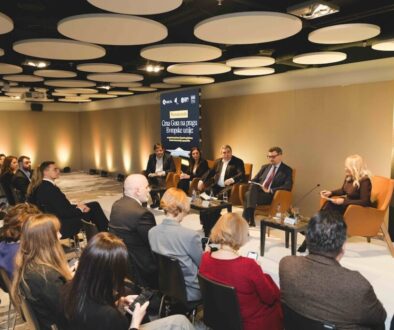
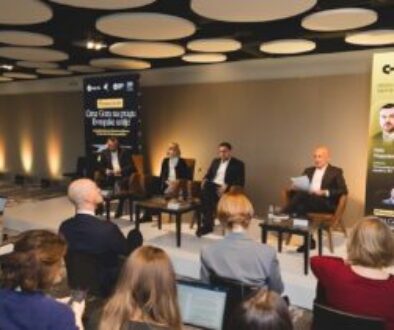
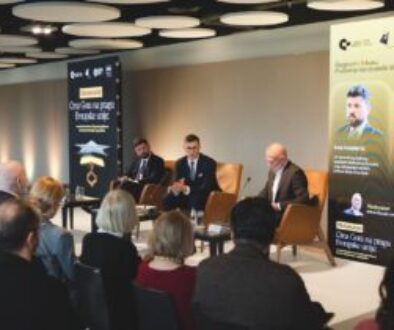
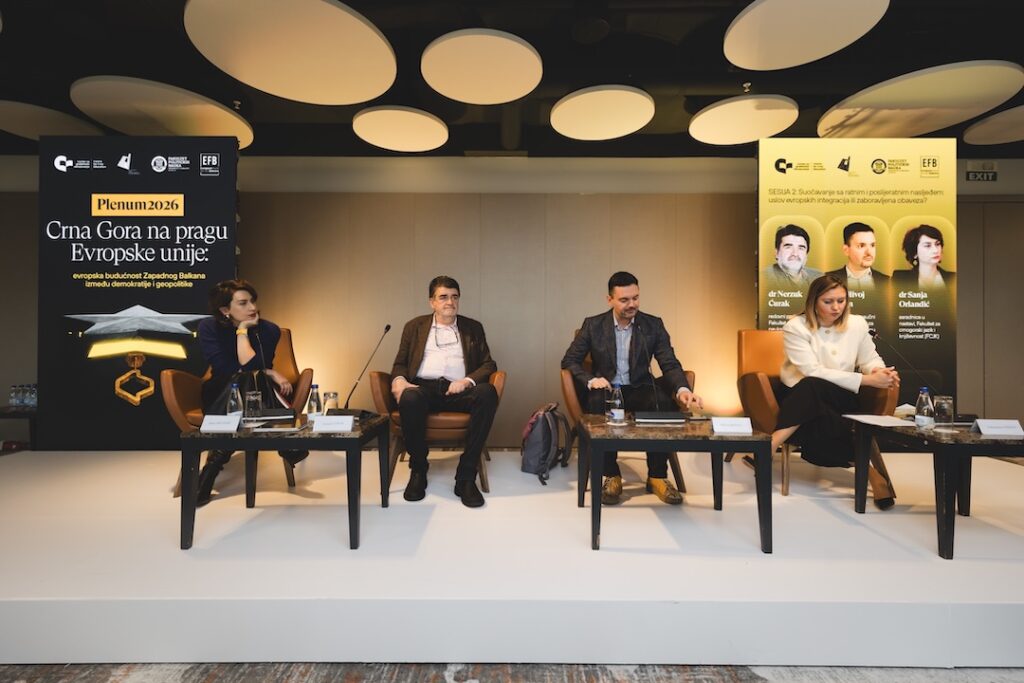
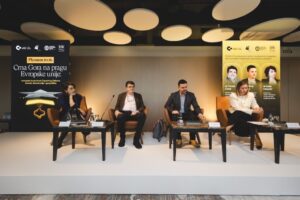
Dealing with the war and post-war legacy cannot remain merely a formal obligation on the European path, but requires clear political responsibility, acknowledgement of victims and consistent rejection of narratives that relativise war crimes and incite intolerance. European integration does not in itself guarantee dealing with the past, and change must be initiated by societies in the region, without expecting the European Union to do this work on their behalf, it was stated at the panel “Dealing with the War and Post-War Legacy: A Condition for European Integration or a Forgotten Obligation?”, held as part of the regional conference PLENUM 2026 “Montenegro on the Threshold of the European Union: The European Future of the Western Balkans Between Democracy and Geopolitics”.
The Plenum is jointly organised by the Centre for Civic Education (CCE) from Podgorica, the Regional Academy for Democratic Development (ADD) from Novi Sad, the Faculty of Political Sciences of the University of Sarajevo (FPN) and European Fund for the Balkans (EFB).
Dr Nerzuk Ćurak, professor at the Faculty of Political Sciences of the University of Sarajevo, assessed that it was time for societies in the region to confront the present, which remains deeply shaped by the legacy of war, rather than constantly invoking the need to deal with the past. „Our present is the past that keeps returning “, said Ćurak, citing the recent attack on a Bosniak pupil in Banja Luka, who, according to him, was beaten by his Serb peers. He particularly criticised the reactions of political officials who condemned the attack and expressed support for the boy, although, in his view, their own rhetoric has for years contributed to creating an atmosphere of intolerance towards Bosniaks. „We are witnessing the utmost hypocrisy of political actors who produce the dehumanisation of Bosniaks on a daily basis and then express concern over the consequences of such policies“, Ćurak emphasised.
In this context, he pointed to the actions of Milorad Dodik, assessing that he uses Islamophobic narratives in his lobbying activities in the United States of America, while simultaneously condemning violence which, in Ćurak’s assessment, is a consequence of the social environment created by such policies. „It is time to stop using politically correct language and to speak about these phenomena clearly and unequivocally“, Ćurak stated, stressing the need to challenge political discourse based on hatred and dehumanisation more decisively.
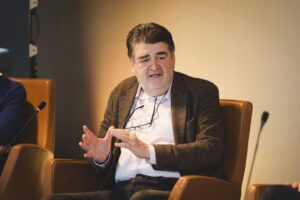
He also welcomed the excellent result of the Student List in Serbia, assessing it as a significant development. Referring to Bosnia and Herzegovina, he warned that even three decades after the end of the war, it still feels as though the conflict ended only yesterday. „We live in a state of negative peace, in which there is no wartime violence, but the causes and patterns that led to it have not been overcome“, Ćurak concluded.
Dr Milivoj Bešlin,historian and Senior Research Associate at the Institute for Philosophy and Social Theory of the University of Belgrade, assessed that Ratko Mladić’s funeral was „a party event of the outgoing criminal regime in Serbia“, organised through the mobilisation of party structures and used for electoral purposes.Nevertheless, he believes that this also offers grounds for optimism, as it indicates weakening support for the regime and changes in public sentiment.
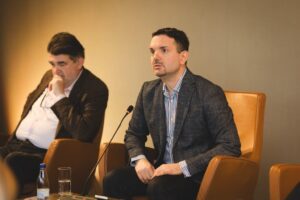
“Even after the democratic changes of 2000, dealing with the past was not based on moral responsibility, but on political and financial interests”,Bešlin recalled, referring to Serbia’s attitude towards war crimes. As an example, he cited the extradition of Slobodan Milošević to the Hague Tribunal in 2001, which the authorities at the time justified by the need to secure international financial assistance. „Since 2001, that process has only gone downhill, and with Aleksandar Vučić coming to power in 2012, a policy of historical revanchism began, which involved the rehabilitation of war criminals, including those from the 1990s“, he explained.
He also questioned the very concept of dealing with the past, assessing that the term has lost its social and political force. „Dealing with the past is no longer a social or political priority today, and new generations neither understand nor use that language anymore“, he warned, stressing the need for new approaches and methods of communication that would make this issue relevant again.
Bešlin also raised the question of consistency in European values, particularly in the context of the strengthening of the far right in EU member states. He recalled that the EU, especially during the tenure of German Chancellor Angela Merkel, had strongly supported Vučić’s regime. „We must ask ourselves what European values are today, where they are defined and to what extent Europe itself adheres to them,“ Bešlin stated.
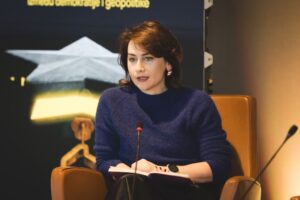
Dr Sanja Orlandić, Teaching Associate at the Faculty of Montenegrin Language and Literature (FCJK), commented on the condolences expressed by the President of the Parliament, Andrija Mandić, to Ratko Mladić’s family, assessing that he thereby sent three messages – personal, party-related and state-level – given that he acted in his capacity as President of the Parliament. „If Brussels were to question him about this action, he could justify it as a matter of custom. The message to his voters was clear, as they expected and welcomed such a move. The third message was addressed to all of us – that the state stands behind such a position“, Orlandić explained.
She also pointed to the significance of Mandić referring to Mladić as a general, as an expression of his attitude towards him and the army he commanded. Referring to the right wing’s invocation of tradition and customs, she stated: „I do not know in what universe expressing condolences to a war criminal constitutes an expression of the tradition of the society to which Ratko Mladić refers“.
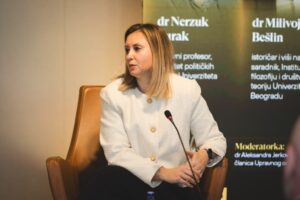
Orlandić stressed that Montenegro must itself initiate a substantive process of dealing with the past, even when this entails a political cost. As examples, she cited the recognition of Kosovo and the apology made by former President Milo Đukanović, which, in her assessment, had significant political consequences. She pointed out that there are currently no political structures willing to assume similar responsibility, nor can European officials be expected to resolve these issues instead of domestic actors. „It is important to clearly identify victims and distinguish them from perpetrators, because equating aggressors with victims can expose political narratives that seek to blur that distinction. In situations such as the one involving Andrija Mandić’s statement, taking a clear position is avoided precisely because it could carry a political cost for him. Therefore, in dealing with the past, we should not rely on the EU, because that is our responsibility“,Orlandić stated, adding that the current government also came to power on a wave of failure to deal with the past.
The panel was moderated by Dr Aleksandra Jerkov, member of the Management Board of ADD.