PLENUM 2026: EU membership by 2028 is a realistic goal, but political accountability and relations with Croatia remain challenges
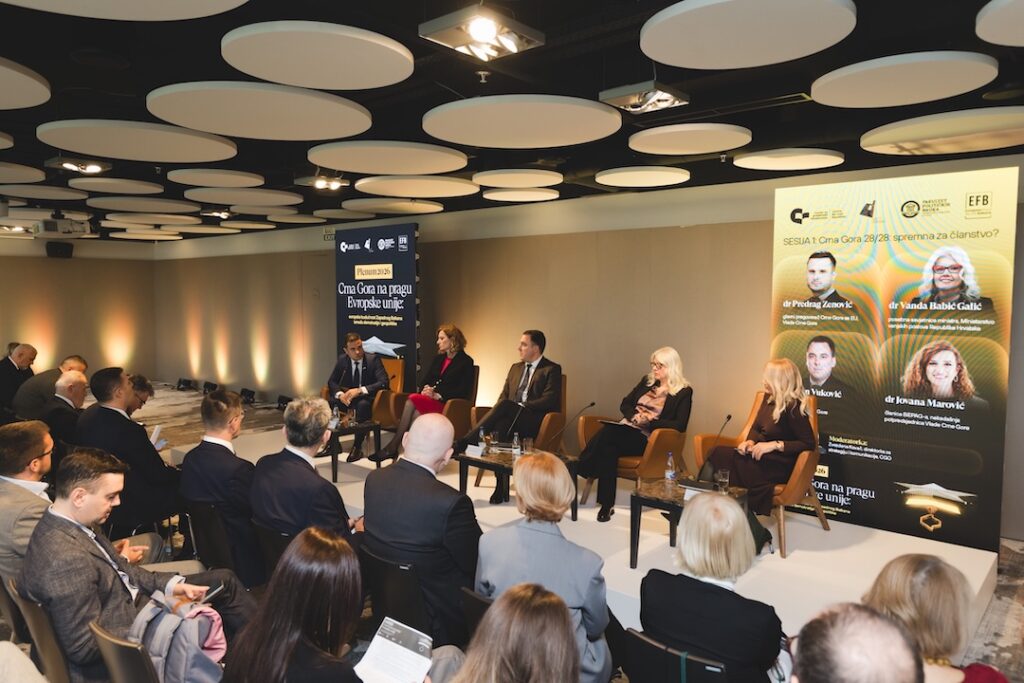
Montenegro’s EU membership by 2028 is an attainable goal, but achieving it depends not only on meeting the closing benchmarks and implementing reforms, but also on political accountability, resolving outstanding issues with Croatia and upholding democratic values. This was the assessment at the panel “Montenegro 28/28: Ready for Membership?”, held as part of the regional conference PLENUM 2026 in Podgorica. The discussion focused on the extent of Montenegro’s formal progress in accession negotiations, tangible results in the rule of law, institutional independence and the fight against corruption, as well as the remaining challenges on the path to European Union membership. Relations with Croatia during the final stage of European integration were also discussed.
Predrag Zenović, Montenegro’s Chief Negotiator with the EU, said that membership by 2028 was a realistic goal, stressing that the latest European Commission report provided grounds for optimism. He stated that Montenegro had met the technical requirements for all 98 closing benchmarks across the negotiating chapters, with an overall score of 3.98.
“Anything we can reasonably envisage achieving by that year is realistic, especially when we have a report confirming our progress. We have grounds for optimism, which must be an integral part of a process determined by the will of all member states,” Zenović said. He stressed that Montenegro’s readiness and the EU’s enlargement policy were important both for the country’s transformation and for the EU’s global standing. “I am convinced that Montenegro will become the next member of the European Union in 2028,” he stated.
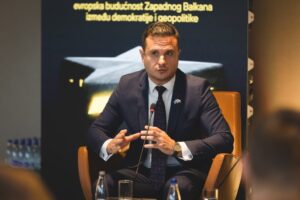
Speaking about relations between Montenegro and Croatia, Zenović highlighted the complexity of two parallel, asymmetric negotiation processes, given that Croatia is an EU member state and Montenegro a candidate country. “I do not believe that Croatia is blocking Montenegro’s path. This is not a matter of negotiating tactics, but of how I view the dynamics of the negotiations. I would like it to remain that way. Although this is an asymmetric relationship, it must be guided by the principle of good faith and respect for fundamental national interests,” Zenović said.
He recalled that enlargement policy involves all EU member states, and that European integration does not imply the disappearance of social differences or political pluralism. “That is why it is important to respect citizens’ representatives in the Parliament of Montenegro, while recognising political differences in approaches to our shared European goal. European integration and the transformation it brings do not, in themselves, guarantee a change in values. That is why we must place the legacy of anti-fascism at the foundation of our system of values,” Zenović stated.
Ivan Vuković, a Member of the Parliament of Montenegro, said that European integration represented a historic choice for Montenegro, comparable to the restoration of independence and NATO membership, and a matter of existential importance to its political future. “When I think about the European Union, I see it in the same light as I saw the need for Montenegro to restore its independence in 2006, or later to join NATO. Imagine what our social and political life would look like had we not made those decisions 20 years ago. Compared with the significance of those changes, everything else seems less important to me, which is why I support Montenegro’s accession to the EU as soon as possible,” Vuković said. He emphasised his support for any progress towards EU membership, while warning of the gap between professed values and political practice.
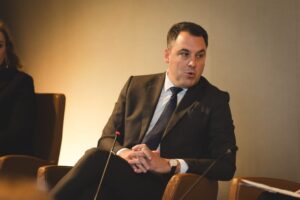
Vuković highlighted the responsibility of the government and the parliamentary majority for the deterioration in relations with Croatia. “It is only fair to say that the government is not solely responsible; the parliamentary majority also bears some responsibility. Relations between Montenegro and Croatia used to be considerably better, and their deterioration is a direct consequence of actions by Montenegrin officials. These range from the resolution on Jasenovac, which added fuel to the fire, to Andrija Mandić’s expression of condolences to Ratko Mladić’s family. Those individuals bear responsibility for the escalation of tensions, which is why we have spent the past two months negotiating the most sensitive issues,” he said.
Speaking about the opposition’s role, he stressed that the Democratic Party of Socialists (DPS) had supported every step that increased Montenegro’s chances of seizing this historic opportunity for EU membership. “If circumstances have put Spajić and his party in charge of this process, that should be an opportunity for all of us. Yet this approach has often been met with disparaging remarks about the opposition made to international partners,” Vuković stated.
Vanda Babić Galić, Special Adviser to the Minister of Foreign Affairs of the Republic of Croatia, emphasised the importance of continuous dialogue between Montenegro and Croatia, noting that frequent meetings demonstrated Croatia’s willingness to help resolve outstanding issues. She recalled that Croatian Prime Minister Andrej Plenković, during his recent visits to Tivat and Budva, had clearly outlined Croatia’s expectations. These were not new, but dated back to 2012 and had been further specified in a 2023 non-paper.
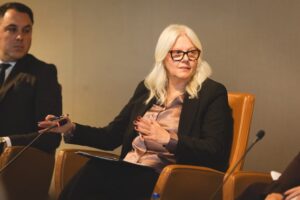
“This is not just about outstanding bilateral issues. These are primarily questions of values, and addressing them advances Montenegro’s own democratic development,” Babić Galić said. Drawing a parallel with education, she stressed that a degree is earned through knowledge and hard work, rather than by bypassing requirements, and that Montenegro has a historic opportunity to demonstrate its readiness for EU membership by meeting the necessary conditions. She also noted that two of the eight conditions had so far been met – those concerning the memorial plaque in Morinj and the name of the swimming pool in Kotor – but only on paper, with implementation still pending.
“It saddens me to hear claims that Croatia is blackmailing or blocking Montenegro. Croatia is neither blackmailing nor blocking Montenegro; it clearly set out, in good time, what it expects and which conditions Montenegro needs to meet,” Babić Galić stated, recalling the hand of friendship extended by Croatia and its continued support for Montenegro, from NATO accession to European integration and accession negotiations. “Good neighbourly relations, the rule of law – and Montenegro closes chapters,” she concluded.
Jovana Marović, a member of the Balkans in Europe Policy Advisory Group (BiEPAG) and former Deputy Prime Minister and Minister of European Affairs of Montenegro, said that signing an EU accession treaty in June 2027 was realistic, even if Montenegro did not manage to close all negotiating chapters by the end of this year. However, she warned that obstacles remained, particularly in relations with Croatia, despite the European Commission’s assessment that the necessary conditions had been met. “It is important for Montenegro to take a constructive approach, but also for Croatia to avoid an approach based on blackmail. Outstanding bilateral issues should be resolved within clearly defined deadlines, potentially through the accession treaty, but without undermining the negotiation process,” Marović stressed.
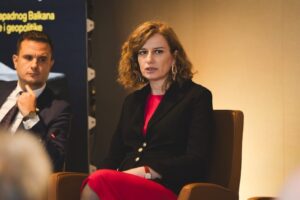
She placed particular emphasis on the values underpinning European integration, arguing that Croatia and other EU member states should insist that Montenegro cannot join the EU while Andrija Mandić heads its Parliament, as his conduct is incompatible with European values. “We often hear that politicians should be asked not about what they said yesterday, but about what they are saying today. We cannot turn a blind eye to what Andrija Mandić and his party have said and done, or to their responsibility for events in the former Yugoslavia during the 1990s,” Marović stated. She was also unequivocal that the approach to the legacy of the 1990s must constitute a clear red line where values are concerned, and that these issues must not be sidelined.
Turning to the European Commission document, which has yet to be considered by member states, Marović warned of the complexity of the proposed safeguards, particularly the possibility of stripping new member states of voting rights in the Council of the EU through a simpler procedure than that applied to existing members. She considered this a far more serious issue than the exercise of veto powers, as it creates legal uncertainty.
The panel, attended by more than 70 participants, was moderated by Zvezdana Kovač, Director of Strategy and Communications at the Centre for Civic Education (CCE).
The regional conference PLENUM 2026 is jointly organised by the Centre for Civic Education (CCE), the Regional Academy for Democratic Development (ADD), the Faculty of Political Sciences at the University of Sarajevo (FPN) and the European Fund for the Balkans (EFB).