PLENUM 2026: Montenegro can restore credibility to EU enlargement, but geopolitical interests must not sideline democracy
Montenegro’s membership in the European Union could be a historic achievement, but only if accompanied by substantive democratic transformation, stronger institutions and the rule of law. The geopolitical importance of the Western Balkans must not become a substitute for its democratisation, nor can stability be built on fear, the concentration of power and the erosion of accountability. These were among the key messages from the official opening of the seventh edition of the regional conference PLENUM 2026, “Montenegro on the Threshold of the European Union: The European Future of the Western Balkans Between Democracy and Geopolitics”, taking place from 8 to 10 November in Podgorica.
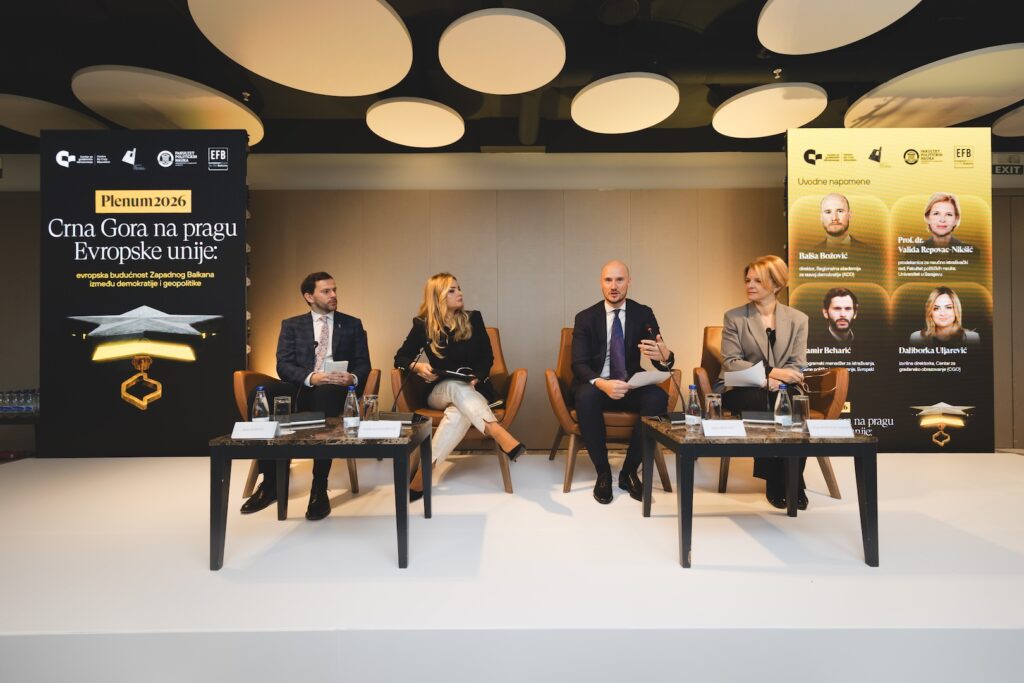
The conference was opened on behalf of the organisers by Daliborka Uljarević, Executive Director of the Centre for Civic Education (CCE); Balša Božović, Director of the Regional Academy for Democratic Development (ADD); Valida Repovac Nikšić, Vice-Dean for Research at the Faculty of Political Sciences, University of Sarajevo; and Samir Beharić, Programme Manager for Research, Policy and Advocacy at the European Fund for the Balkans (EFB).
Daliborka Uljarević said that this year’s PLENUM was taking place at a moment that could mark a turning point for Montenegro and the Western Balkans, but warned that approaching membership does not automatically mean being fully prepared. “Being close to the European Union is not the same as being ready to join it. European integration must lead to changes in how the country is governed, how institutions function and how citizens’ rights are protected. EU membership must not be a reward for political actors conducting negotiations on the back of renewed momentum for enlargement, but confirmation that society has become more democratic, institutions more professional, and citizens freer and more secure,” Uljarević stated.
“The geopolitical importance of the Western Balkans cannot be a substitute for its democratisation,” Uljarević warned, reflecting on the renewed geopolitical significance of enlargement. She noted that this presents an opportunity for the region, but also carries the risk of diluting democratic criteria and prioritising political stability over the rule of law.
She also stressed the responsibility of domestic institutions, recalling that reforms must be implemented for the sake of citizens, who deserve functioning institutions, an independent judiciary and equal protection of their rights. “The European Union cannot be more committed to democracy in our countries than our own institutions are to building and protecting it,” she said.
Speaking about the challenges facing Montenegro, Uljarević emphasised that the success of its European integration process will be measured not only by the date of accession, but also by the quality of its institutions and their resilience to political pressure. She also warned that the pace of reforms must not come at the expense of their quality, and that the region’s European future cannot be built on a selective approach to its wartime past.
“The democratic strength of a state is reflected not in how much the government can control society, but in how effectively institutions can hold the government to account. We urgently need the rule of law, not someone’s right to rule,” she stressed, adding that stability based on fear, obedience and the concentration of power is unsustainable.

“Montenegro’s membership in the EU could be a historic achievement. But it would be a historic failure to join the Union without changing the patterns of governance that have distanced us from its values for decades. That is why our goal must be not only membership in the European Union, but a Montenegro in which citizens live by European values and enjoy the rights and standards they have long deserved,” Uljarević concluded.
Balša Božović emphasised that this year’s PLENUM was taking place at a particularly important political moment, following elections in Bosnia and Herzegovina, Serbia and the United States, which further underscore the significance of the topics to be discussed. “Montenegro’s accession to the European Union is at the heart of this PLENUM. This is of fundamental importance to Montenegro itself, but also to the entire Western Balkans. Montenegro’s membership would demonstrate that enlargement is possible once again. That is why we will also discuss the outstanding issues with Croatia. These should be resolved alongside the closure of negotiating chapters by the end of the year. Waiting for one process to finish before beginning the other would only slow both down,” Božović stressed.
Reflecting on political changes in Serbia and their potential impact on the region’s stability and European prospects, he stated that “only a democratic Serbia that respects the sovereignty of its neighbours can make a lasting contribution to regional security and to its own European future, in line with the aspirations of citizens who voted for change”.
He also highlighted changes in transatlantic relations, stressing the need for Europe to take greater responsibility for its own defence and continue supporting Ukraine in confronting Russian aggression, as the stability of the Western Balkans also depends on European security. “I believe this is a time for bold political ambitions and faster progress towards full EU membership. Europe is uniting, and we must not fall behind. Exceptionally interesting times lie ahead,” Božović concluded.
Professor Valida Repovac Nikšić expressed her satisfaction that the Faculty of Political Sciences at the University of Sarajevo was among the partners of this regional gathering, emphasising the importance of cooperation and creating space for open, reasoned, critical and interdisciplinary dialogue on the key political and social challenges facing the Western Balkans.

She focused in particular on the significance of Montenegro’s potential EU membership for the entire region, as well as the capacity of enlargement policy to address current democratic and security challenges. “Montenegro’s progress, also confirmed by the latest European Commission report, could provide an important impetus and encouragement for the entire region. At the same time, the lack of progress on reforms and the almost complete standstill in Bosnia and Herzegovina’s European integration process are causes for concern,” Repovac Nikšić stated.
Discussing political developments in Serbia, she highlighted the encouraging role of civic mobilisation and political changes that could help ease tensions and strengthen regional stability. “European integration should not be reduced to formally meeting criteria, but should be understood as a process that brings about substantive and lasting social transformation. This step forward involves building societies founded on trust, solidarity, mutual respect and equal opportunities, strengthening social cohesion and developing a culture of dialogue and cooperation,” Repovac Nikšić said, adding that such transformation requires sustained efforts to confront the past and work towards reconciliation.
“The Western Balkans’ European path can be sustainable in the long term only if, alongside institutional reforms, it helps overcome social and political divisions, strengthen democratic culture and create the conditions for a fairer, safer and more prosperous future for all citizens of the region,” Repovac Nikšić concluded.
Samir Beharić emphasised the significance of political changes and growing civic engagement, particularly among young people. “In different parts of the world, we are witnessing an increasingly powerful wave of democratic resistance to authoritarian policies – from Hungary, through Serbia last month, to the United States last week. It is also encouraging that this wave is accompanied by high voter turnout, particularly among young people, who are shaping political reality not only on the streets through protests, but increasingly at the ballot box and even by standing as candidates,” Beharić said.
He also stressed that these trends are important for the Western Balkans. “For our region, which aspires to EU membership, these are positive trends because young people are not only the future of our democracies – they already represent one of their key pillars and driving forces for political change,” Beharić stated.
In this context, he emphasised the importance of PLENUM as a forum for exchanging ideas, building connections and taking joint action among those who share democratic values, particularly at a time when protecting those values requires solidarity and cooperation.
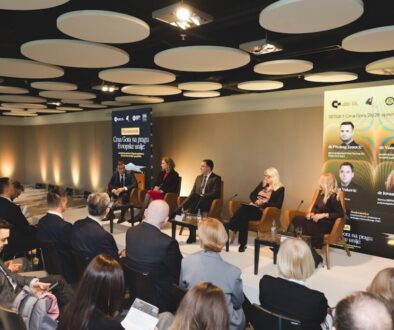
PLENUM brought together around 70 representatives of institutions, academia and civil society, as well as experts from Montenegro, the wider Western Balkans and the European Union, creating space for an exchange of different perspectives on the region’s democratic and European future.