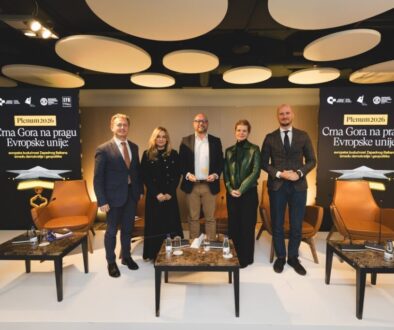
PLENUM 2026: Geopolitical Changes Call for a Stronger Europe and a More Responsible Western Balkans
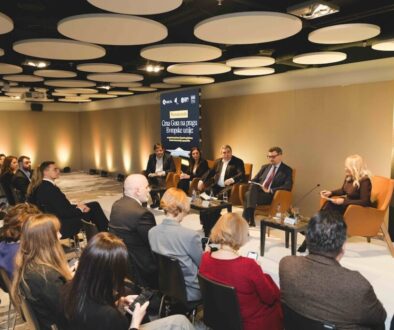
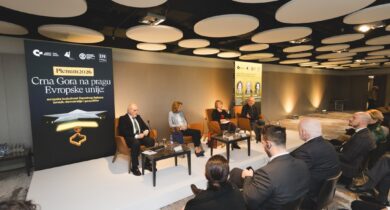
Geopolitical changes and the reassessment of transatlantic relations require Europe to assume greater responsibility for its own security, while Western Balkan countries must take a more active role in shaping their future instead of waiting for decisions by major powers. Despite challenges within NATO, shared strategic interests remain the foundation of the alliance, while political changes in the US and the region open up opportunities for new relations based on democratic values, stability and mutual respect, it was stated at the session “The US and the EU: A Fading Alliance and the Balkans in a New Geopolitical Order”, which opened the final day of the regional conference PLENUM 2026, “Montenegro on the Threshold of the European Union: The European Future of the Western Balkans Between Democracy and Geopolitics”, held in Podgorica.
The conference is jointly organised by the Centre for Civic Education (CCE) from Podgorica, the Regional Academy for the Development of Democracy (ADD) from Novi Sad, the Faculty of Political Sciences of the University of Sarajevo (FPN) and the European Fund for the Balkans (EFB).
The session focused on the impact of the US congressional election results on transatlantic relations and US policy towards the Western Balkans, opportunities to strengthen European strategic autonomy, and the space that the weakening of traditional alliances creates for other global actors, particularly Russia and China.
Vesna Pusić, former Deputy Prime Minister and Minister of Foreign and European Affairs of the Republic of Croatia, believes that the US congressional election results confirm the importance of active political engagement. “It always seems impossible until it is done”, she recalled the words of Nelson Mandela, emphasising that politics requires initiative. „emphasising that politics requires initiative. “There are many lessons for us in the region: nothing good will happen if we simply wait“, Pusić said.

Speaking about broader geopolitical changes, she stressed that Donald Trump’s rise to power had made the shift in international relations more visible. „It did not all begin with the Trump administration, but it became apparent under it. One could say that all three world powers are now on the same side when it comes to dividing the world into spheres of influence, which was not the case before“, Pusić stated, warning that „small countries have considerably less room for manoeuvre in such an order, which makes a clear strategy and political initiative particularly important“.
She also assessed that the US elections are significant for the Western Balkans, pointing to certain similarities between the political situations in the US and Serbia. „These are two very different countries, one exceptionally large and the other small, but there are certain similarities. We do not know what will happen after these elections, but we do know that an entrenched government has been shaken. The extent to which it will recover and how much its influence will change remains to be seen, but this is an important and necessary step“, Pusić said. Analysing the reasons behind the Democrat’s electoral success in the US, she pointed out that, alongside economic issues and the cost of living, dissatisfaction with the authorities’ treatment of citizens and the undermining of their dignity also played an important role. „I think this was also a rebellion against recklessness, contempt and violence towards citizens and their dignity. I recognise similar elements in the election results in Serbia“, Pusić emphasised, adding that it remains to be seen how the newly elected representatives will make use of the opportunity they have been given.
Veton Surroi, a publicist from Kosovo, assessed that the world is undergoing tectonic geopolitical changes, while the US strategic shift towards the Pacific further highlights the need for Europe to assume greater responsibility for its own security. He pointed to the importance of distinguishing long-term US interests from the policies of the Donald Trump administration and Congress, assessing that the Western Balkans are no longer among US priorities. He particularly highlighted a bipartisan legislative initiative in the US Congress concerning regional stability, European integration and the normalisation of relations between Serbia and Kosovo. „The next two years will be crucial for aligning regional interests with US policy“, he stated.
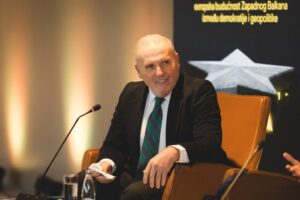
Reflecting on the region, Surroi assessed that stabilitocracy had dominated the approach of Western partners towards the Western Balkans over the past fifteen years or so. “Leaders such as Aleksandar Vučić enjoyed support because they had the capacity to destabilise, with the expectation that they would not use it. Such an approach produced political and social inertia, but we can see that this is now changing“, he said, pointing to the elections in Serbia and protests in Albania. He added that economic pressures, particularly rising prices and dissatisfaction with government policies, are becoming increasingly important drivers of social change.
„Montenegro has a significant advantage because it is expected to sign the EU accession treaty in 2027, but it is crucial that no security vacuum emerges between signing and ratification“, Surroi warned. He stressed that geopolitical crises, particularly in Ukraine and the Middle East, confirm the need for a policy of peace. „Europe cannot be a continent of peace unless the Western Balkans become its shared space of peace“, he concluded.
Dr Milica Pejanović Đurišić, former Minister of Defence of Montenegro and diplomat, assessed that transatlantic relations are going through a crisis, but that genuine differences in the strategic interests of Europe and the US must be distinguished from political reactions that occasionally heighten tensions. She recalled that these challenges did not begin with the Donald Trump administration, but were also present during Barack Obama’s, term in office, when US foreign policy was increasingly shifting its focus towards the Pacific. „Even then, it was not easy to explain why Montenegro’s place was in NATO, not because of conflicting strategic interests, but because the US focus was elsewhere“, Pejanović Đurišić said, emphasising the importance of persistent dialogue and presenting shared interests. She recalled that the allies, despite their differences, had reaffirmed their shared strategic objectives at the most recent NATO summit, while their position on Ukraine remains an important test for the future of the alliance. She also expressed the expectation that the new US Congress would contribute to preserving NATO’s stability.

Speaking about Russian influence, she stressed that Montenegro had recognised relatively early the risks it posed to democratic processes and European and Euro-Atlantic integration. She recalled attempts to polarise society and slow down reforms during Montenegro’s accession to NATO, noting that it later became clear that Russia’s opposition was directed at the broader integration process. “Although the struggle to draw attention to this influence sometimes seemed quixotic, our society recognised the risks and became more cautious,” she stated.
She assessed that there is now greater awareness of Russian influence, while institutions, despite their weaknesses, are gradually strengthening their capacities to recognise and counter it, with the support of the European Commission and its mechanisms. “It is not perfect, but it is better than it was ten years ago,” Pejanović Đurišić concluded, while also expressing dissatisfaction with the current state of the relevant institutions.
The panel was moderated by journalist Adnan Rondić.