
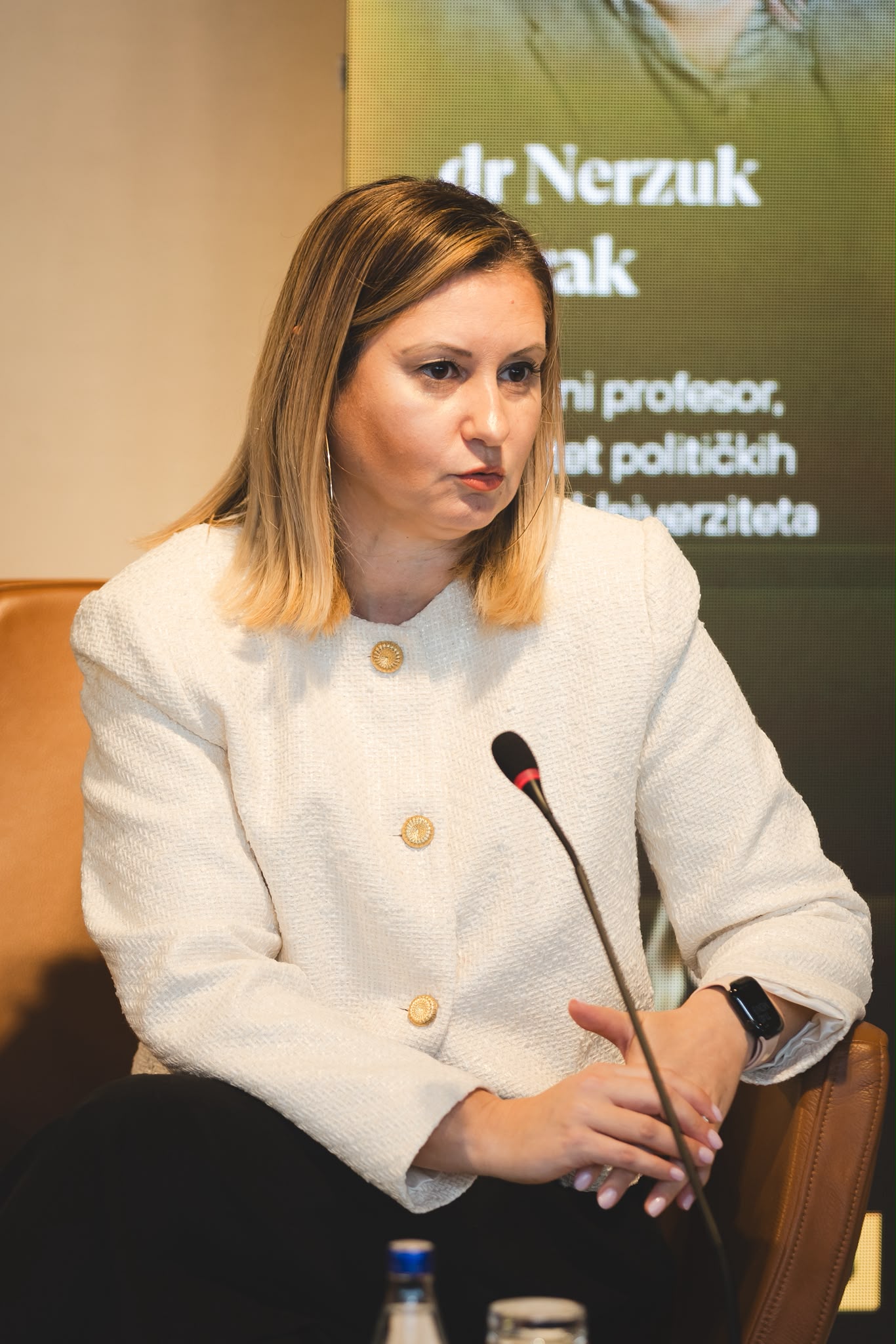
Jerkov at the Cetinje Forum: Serbia Cannot Achieve Lasting Democratisation Without Breaking with the Policies of the 1990s
Dr Aleksandra Jerkov, a member of the Governing Board of the Regional Academy for Democratic Development, told the Cetinje Forum FORCE 2026 that Serbia’s democratisation requires a clear break with the politics and values of the 1990s, respect for the sovereignty of neighbouring states, and comprehensive institutional reform. Speaking about the crisis of democracy in the Western Balkans and the opportunities missed after 2000, she stressed that removing an authoritarian government through elections must be followed by dismantling the system that enabled it to survive and return to power.
“The policies pursued in the 1990s led to military defeats and catastrophic consequences, but there was no clear social and political break with the idea that had produced those outcomes. The belief persisted that the problem lay in the circumstances, the international community or poor tactics, while the objective itself was justified,” Jerkov said.
In her assessment, this interpretation of the past allowed the belief to endure that nationalist projects were not fundamentally wrong, and that their implementation merely required more favourable international circumstances. She also sees this as the link between the wartime policies of the 1990s and the contemporary concept of the “Serbian world”. Jerkov stressed that, behind a different name, the same idea persists: that Serbia has the right to determine political life in neighbouring states, that state power can be extended on the basis of ethnic affiliation, and that Belgrade represents all Serbs, regardless of where they live.
She warned that such policies have direct consequences for democracy within Serbia itself.
“If some historic battle is always being fought, citizens are asked to postpone their demands for free media, independent courts and a decent life. Nationalism thus provides a justification for authoritarian rule, while authoritarian rule sustains nationalism because its political survival depends on it,” she emphasised.
Discussing relations with neighbouring countries, Jerkov said that Serbia cannot complete its democratisation while denying other societies the right to decide their own future. Respect for neighbouring states, she explained, will not in itself ensure free elections or an independent prosecution service. However, without this shift in values, democratic rights can continue to be subordinated to an alleged higher national interest.
She paid particular attention to Serbia’s approach to Montenegro, arguing that formal recognition of its independence had not been accompanied by genuine acceptance of its sovereignty among a significant number of political actors in Serbia.
“Sovereignty also means Montenegro’s right to make decisions that Belgrade does not like. To elect its own government, manage its own relations and determine its own European path. Montenegrin identity cannot be treated as hostility towards Serbia,” Jerkov said.
Regarding Bosnia and Herzegovina, she stressed that a responsible Serbian policy requires respect for its sovereignty, territorial integrity and institutions, as well as an end to support for secessionist projects. She emphasised that Republika Srpska is part of Bosnia and Herzegovina and that Belgrade’s policies should help people live in safety and freedom, rather than sustain expectations of future changes to borders.
An equally substantial shift is needed towards Kosovo, she argued: accepting the reality of Kosovo’s independence and establishing a lasting framework for relations, with policies focused on people’s everyday lives, the security of the Serb community, and the protection of property rights, political rights and cultural heritage.
“A policy that keeps people in uncertainty for years in order to preserve its own power cannot be described as concern for their wellbeing,” Jerkov said.
A significant part of her remarks addressed confronting war crimes and the responsibility of political elites for how societies relate to the past. She highlighted the Regional Academy for Democratic Development’s work analysing media coverage of war crimes and war criminals, warning about the consequences of their return to public life as political and social authorities.
She stressed that acknowledging the Srebrenica genocide, respecting facts established by courts, and providing education that enables young people to understand what happened are integral to democratic development.
“We owe it to the victims to confront the past, but we also owe it to our own society: to its ability to recognise and reject a renewed politics of violence,” she said.
Reflecting on the period following 5 October 2000, Jerkov argued that the electoral victory over Slobodan Milošević had not been translated into a sufficiently profound break with the system that sustained him. At the same time, she rejected equating that period with Vučić’s regime, recalling that democratic change had brought genuine freedoms, political competition, a European perspective and the possibility of changing governments.
“That is precisely why we have a duty to speak honestly about why that opportunity was not secured for the long term. The political forces to which I belonged also bear their share of responsibility for those failures,” Jerkov stated.
Among the key failures, she identified the absence of effective democratic oversight of the security services and the failure to sufficiently sever ties between parts of the state apparatus, criminal networks and political centres of power. She cited the failure to implement lustration as a concrete example of the lack of political will, while describing the assassination of Prime Minister Zoran Đinđić as an indication of the strength and determination of those opposing democratic change.
She said that reforming the security services must therefore be among the first tasks of the new authorities, alongside establishing accountability for political surveillance, intimidation and the misuse of confidential information.
“If you preserve such an apparatus because you think it will now serve your own objectives, you are leaving a future authoritarian government with a ready-made instrument of repression,” she warned.
Jerkov also pointed to the consequences of party control over public enterprises, the public administration and public appointments, which had weakened professional standards and public trust. She stressed that institutional independence must also apply when institutions investigate representatives of the new authorities, criticise them or make decisions against their wishes.
She added that the experiences of citizens who had lived through the transition as a loss of security and dignity must not be overlooked. Democratic politics, she said, must deliver social security, accessible education and healthcare, and equal protection under the law.
Those leading change today, she concluded, must not repeat the assumption that the departure of one individual alone resolves the problem. What is needed is a public, verifiable plan for rebuilding institutions, individual accountability established through fair proceedings, and continuous scrutiny of those in power by citizens, the media and civil society.
“No one earns the right to be exempt from that scrutiny simply because they helped bring down an authoritarian regime. The success of these changes will be measured by whether we have built a system in which no future president, prime minister or political party can bring the state under their control. That is the task we must complete this time,” Jerkov said.
The fifth Cetinje Forum, FORCE 2026, takes place on 11 and 12 November at Vladin dom in Cetinje, under the title “Beyond Borders – Geopolitics, Human Rights and Leadership in a (Dis)connected World”. The Forum is organised by the Faculty of Montenegrin Language and Literature, the Montenegrin PEN Centre and WestBalkanNet, in partnership with the Regional Academy for Democratic Development and other institutions. Jerkov participated in a panel examining whether democracy has taken root in the Western Balkans, alongside Milena Bešić, Emir Pilav and Tomislav Marković, moderated by journalist Vjera Ljuljđuraj.


