PLENUM 2026: Enlargement Is Becoming a Matter of EU Internal Politics and Its Strategic Future
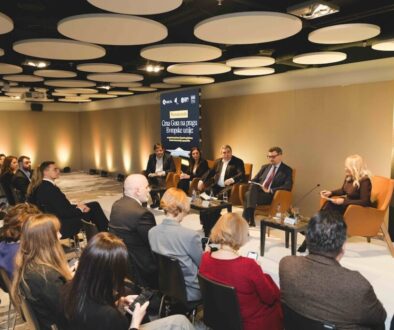
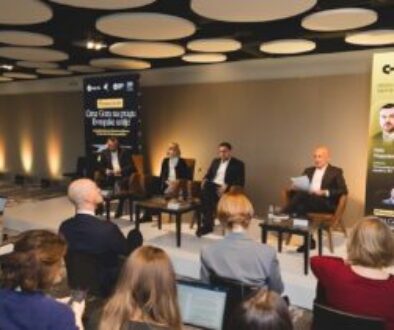
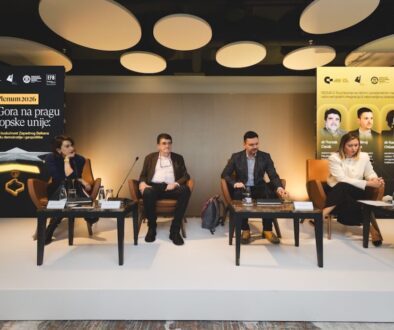
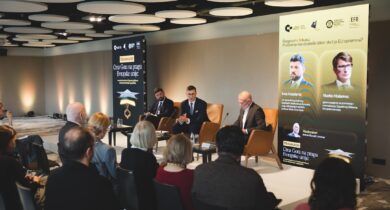
Montenegro must resolve outstanding issues with Croatia regardless of the European integration process, as it is in its interest to maintain the best possible relations with its neighbours. On the other hand, the European Union is ready, and Montenegro will become its next member state, it was stated during the In Focus discussion at the regional conference PLENUM 2026, organised by the Regional Academy for Democratic Development (ADD) from Novi Sad and the Centre for Civic Education (CCE) from Podgorica, in cooperation with tthe Faculty of Political Sciences of the University of Sarajevo and the European Fund for the Balkans (EFB).
The “In Focus: Enlargement as a Strategic Choice: Is the EU Ready?” session, featuring Ivan Ivanišević, Acting General Director of the Directorate General for European Union at the Ministry of Foreign Affairs of the Government of Montenegro, and Marko Makovec, Principal Adviser for Reconciliation and Normalisation in the Western Balkans at the European Commission, was moderated by journalist Adnan Rondić.
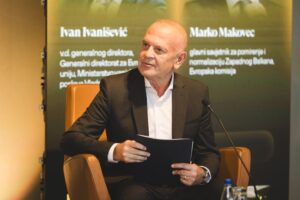
Makovec emphasised that he is using his mandate at the Commission primarily to work on reconciliation, as the EU has not done enough in this area so far. “Why have we not done enough on reconciliation? Because we expected the political elites of the countries in the region to work on it. But they had no willingness to initiate that process,” Makovec stressed.
He also pointed out that numerous politicians in the region had used the wars of the 1990s, as well as other parts of the past, to “conceal the fact that they had not implemented reforms and to maintain certain practices that had existed in the region before the 1990s.”
„The EU is ready. We have a communication from October that best demonstrates this. That document, ‘Preparing for a Wider Europe’, states that the EU has the capacity for enlargement and that we will improve the accession procedure. The European Commission’s proposal is that the decision on accession should not be taken by unanimity, but by a qualified majority, “, Makovec emphasised.
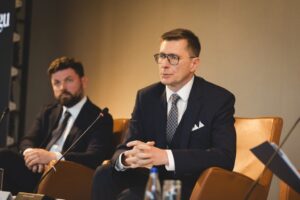
Ivan Ivanišević, on the other hand, assessed that the enlargement process is taking place at its most complex moment to date. „We have a community of peace created on the basis of values after the Second World War and in accordance with procedures that protected the democratic order. We have reached a situation in which that community now needs to respond to circumstances efficiently, quickly and in a coordinated manner. And then, at one point, all European media report that bombs have been planted on one of the flights“, Ivanišević stated, speaking about the hybrid threats facing the EU.
He recalled that the EU can now rely less and less on NATO, also citing the example of Poland, where drones had been deployed along its border.
“The EU must confront this through consensus. A certain consolidation of reconciliation is needed,” Ivanišević pointed out.
Makovec agreed with this assessment and recalled that the enlargement paradigm changed with the beginning of Russia’s aggression against Ukraine. „This does not apply only to the Western Balkans region. It primarily concerns the northern dimension – Great Britain and the four points on the basis of which we will hold discussions about its return to the EU. It also concerns Ukraine, Moldova, Norway, Iceland, as well as Turkey, which is very important to the EU“, Makovec emphasised.
He recalled that values are the foundation of the EU and what distinguishes it from the rest of the world. „The rule of law is reflected in democratic institutions, an independent judiciary, the police, freedom of speech and media freedom – this is what constitutes the EU and why people from the region want to be part of it“, Makovec stated.
Ivanišević pointed out that the countries of the region have for years faced narratives that slow down their path towards the EU. „These narratives have built a certain identity framework that translates into political action. You can see it in numerous examples, and the moving around of the monument to Pavle Đurišić is one of them“, Ivanišević said.
Asked to what extent the actions of certain politicians, such as Andrija Mandić, make the work of the Ministry of Foreign Affairs on European affairs more difficult, Ivanišević said that he could not interpret any political figure. „But what I can say is that gestures by any politician that do not contribute to promoting the values important to our negotiating process make things more difficult for us. From technical matters, such as negotiations with Croatia, onwards, there are many such examples“, Ivanišević explained.
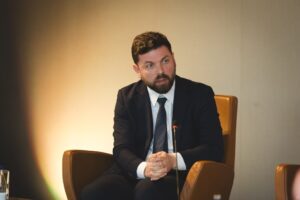
Speaking about what Montenegro should do in its relations with Croatia, he stated that these issues must be resolved independently of negotiations with the EU. „I think we should develop capacities that will contribute to awareness of the fact that this is our immediate neighbour, which helped us with NATO membership, shared translations of the EU acquis and provided us with so much assistance“, Ivanišević stated.
Makovec agreed with this. „Some countries have additional political demands in the negotiation process. Namely, once a new member joins, the EU becomes larger, and this means that Montenegro will have all the rights and responsibilities of other countries. However, enlargement policy is no longer the European Union’s foreign policy, but its internal matter“, Makovec concluded.