The Annual Plenum Award for the Fight for Democracy and Human Rights has been presented this year to the Free University of Novi Sad, which, in a year marked by student uprisings and deep social turmoil, demonstrated what academic courage looks like. While institutions were captured, this network of professors, teachers, and researchers stood by the students, defending the integrity of knowledge and the right to freedom of thought.
The Academy for the Development of Democracy (ADD), the Centre for Civic Education (CGO) in Podgorica, the Faculty of Political Sciences of the University of Sarajevo (FPN), and the Friedrich Ebert Foundation (FES), as the organizers of the regional plenary, award this recognition to initiatives and communities whose work makes an exceptional contribution to the defense and advancement of democracy and human rights in the Western Balkans.
Founded only a year ago, the Free University of Novi Sad has become a symbol of academic integrity and solidarity, civic courage, and resistance to an undemocratic regime. Their work shows how professional integrity and social responsibility can be lived and defended even under political pressure.
“Of particular importance to us is that this award goes to Novi Sad – a city that, even under the weight of great tragedy, has shown the strength to carry the torch of resistance and hope. Montenegro was, even during the Milošević regime, a refuge for those fighting for freedom in Serbia. Today, when the government in Montenegro supports the autocrat who has extinguished pluralism in Serbia, we want to send a clear message: civic Montenegro stands with free people, with those who refuse to surrender to fear but turn it into strength, and strongly supports the free-thinking citizens of neighboring Serbia,” emphasized Daliborka Uljarević, Executive Director of CGO, while presenting the award on behalf of the organizers.
On behalf of the Free University, the award was accepted by Professors Nataša Milićević, Ljubica Oparnica, and Vanja Manić Matić.
“We see this award as recognition for the entire rebellious and free academic community in Serbia, and we dedicate it to our comrades – all disobedient citizens of Serbia. Serbia is not the only country where university autonomy has been undermined, but it is the country where the effort to subjugate the university has grown into brutal and blatant repression. As long as the authorities view students as enemies, we will continue to demonstrate that the movement exists and that our position is clear: one resistance, one university,” stated Nataša Milićević.
“After thousands of our students began their unique and extremely difficult struggle for justice and accountability, it was our duty to support them and initiate the fight for a free university. Many battles have begun and are ongoing. The consequences are institutional and administrative pressures. The struggle for basic autonomy, for labor and human rights protections of the academic community and society, is difficult,” Milićević said, adding that the Free University of Novi Sad has also recently filed a historic lawsuit against the Ministry of Interior for violating the spatial autonomy of the university, infringing upon personal rights, and violating the labour rights of employees at the University of Novi Sad.
“With this recognition, the Plenum reaffirms its commitment to supporting those who defend the space of freedom, dialogue, critical thinking, and democracy — values that are more endangered today than ever, yet continue to endure thanks to brave individuals and communities such as the Free University,” the award statement concludes.
Closing session of the Regional Plenum in Podgorica
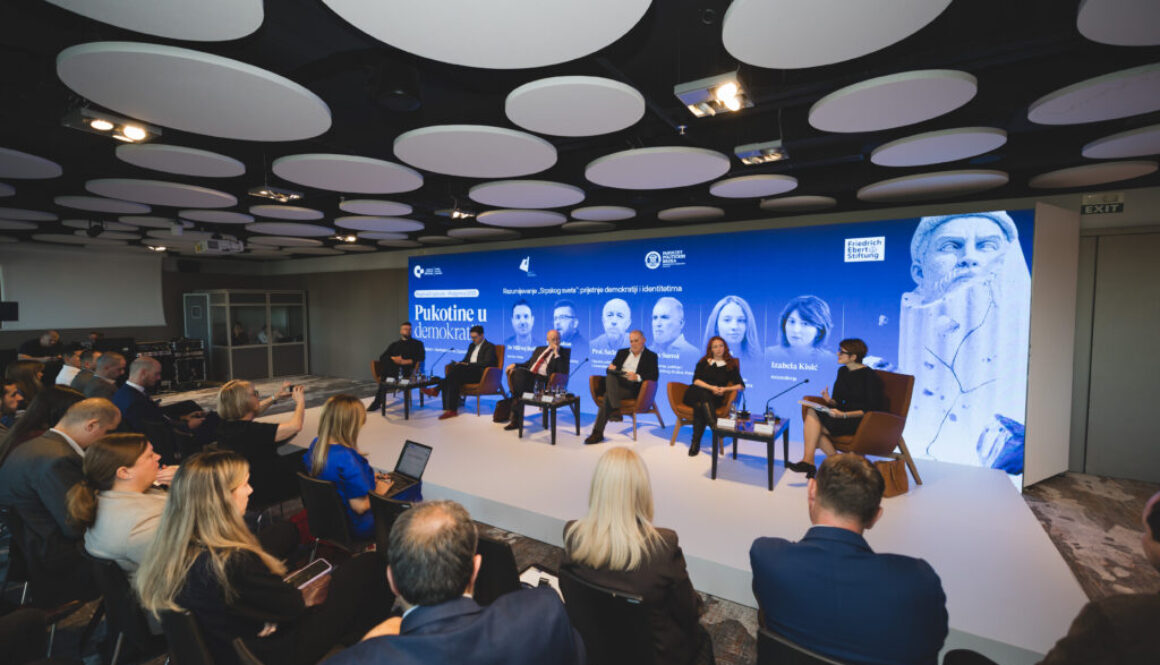
The ideology of the “Serb World” is a continuation of Greater-Serbian projects from the 19th century to the present day, and effectively countering this idea in Montenegro requires emphasizing the Montenegrin national question and addressing the functioning of the church as one of the fundamental prerequisites for stability. This was among the key messages delivered during the panel “Understanding the ‘Serb World’: Threats to Democracy and Identities,” held as part of the second session of the regional plenary “Fractures in Democracy: Nationalism and Clericalism in the Western Balkans,” jointly organized by the Academy for the Development of Democracy (ADD), the Centre for Civic Education (CGO) in Podgorica, the Faculty of Political Sciences of the University of Sarajevo (FPN), and the German Friedrich Ebert Foundation (FES).
Director of the Western Balkans Network, Dr. Boban Batrićević, reminded that the “genius of evil” behind the Holocaust lay in the fact that Nazi Germany devised a system in which the people taken to the crematoria ultimately paid for their own destruction—their transport to the camps, their accommodation and food—because they worked, received wages, and financed the machinery that annihilated them. He drew a parallel between this and the methods used by the current Serbian regime against its opponents.
“The ideology of the ‘Serb World’ is a continuation of Greater-Serbian projects from the 19th century to the present day. Unlike the concept of ‘Homogeneous Serbia,’ here we do not have a document that outlines the plan; it is hidden, and that is what makes it perversely ingenious,” he said.
Batrićević emphasized that one cannot prepare the ground in advance for the fight against the ideology of the “Serb World,” because it is an adaptive concept. According to him, this ideology controls 49 percent of the territory in Bosnia and Herzegovina (BiH), has historical roots in Montenegro and currently governs the entire state apparatus there—something it cannot achieve in BiH—and is present only symbolically in Kosovo today.
The Serb World is, in my view, very well organized, because it rests on an intelligence, economic, media, and cultural paradigm, which enables Serbia to interfere in the affairs of independent neighboring states,” he said, stressing that it is particularly problematic that Western partners do not fully grasp how sophisticated this concept is in the case of Montenegro.
“Census data show that Montenegrins are disappearing without a war, meaning that the ideology of the ‘Serb World’ is most effective precisely without conflict. This is why the Montenegrin national question must be framed as an issue of European security. Without a Montenegrin nation, the stability of the Western Balkans is endangered. Reducing Montenegrins to 35 or 30 percent of the population—which is the goal of the Serbian Orthodox Church and Serbian representatives in Montenegro—leads to a situation in which the largest constituent group in Montenegro becomes excluded from decision-making, and what we get is a ‘state of peoples’,” Batrićević explained.
He stressed that the problem of the Montenegrin nation is that it is too small to control the state institutions that should be responsible for nurturing Montenegrin national identity. “Our task is to try—with the help of Priština and Sarajevo, and then the EU—to raise the question of how the church functions in Montenegro. Without a serious Montenegrin church—a church of the Montenegrin people, a church of Montenegro, an Ecumenical Metropolitanate in Montenegro, whatever we choose to call it—we cannot move forward,” Batrićević said.
The historian from Serbia, Dr. Milivoj Bešlin, stated that from Serbia’s perspective, the idea of the “Serb World” is not new. It is merely a new term, borrowed from Russian state propaganda, while the underlying concept has existed since the 19th century under the name Greater Serbia.
The idea of the ‘Serb World,’ which was once called ‘our extended homeland’ during the creation of the Kingdom of Serbs, Croats and Slovenes, later ‘Homogeneous Serbia’ during the Chetnik movement, and at times simply ‘Greater Serbia,’ is fundamentally territorial in nature and has always implied all territories where Serbs live. This is why the Serbian question in the region has been viewed as a territorial question. Territory was the key element,” he explained.
Bešlin stated that these concepts always required gathering all Serbs into a single state. “But that is not all. Greater-Serbian imperial ideas have always included an attitude toward others, not only toward the Serbian population. Among other things, this meant expelling the Muslim population as a ‘foreign element’ from this projected state, punishing Croats historically, and transforming Montenegrins in terms of identity,” he said.
“A great-state project must, by definition, include homogenization. If you eliminate national and identity pluralism, you eliminate political pluralism as well. That is why the idea of the ‘Serb World’ is actually directed against Serbia itself, and especially against a democratic Serbia,” Bešlin stressed.
He pointed out that today the Greater-Serbian project has tactically abandoned territory, and instead applies a doctrine of limited sovereignty over neighboring states. “Borders are not openly challenged, but the sovereignty of those states is fundamentally undermined. According to this logic, Vučić is not the president of Serbia, but the leader of all Serbs in the region. The people are the bearers of sovereignty, so Vučić becomes the bearer of sovereignty in Serbia, Montenegro, Bosnia and Herzegovina, and he sees himself as possessing it even in parts of Croatia,” Bešlin said.
Professor at the Faculty of Political Sciences of the University of Sarajevo, Dr. Šaćir Filandra, stated that Bosnia and Herzegovina has been an object of the ‘Serb World’ for the past 150 years in a practical sense. However, in his view, the “Serb World” and “Greater Serbia” are not synonyms.
“The project of Greater Serbia has definitively failed as a state project. This is difficult for its proponents to admit, but it has failed. The ‘Serb World’ appears as a cultural substitute adapted to new geopolitical circumstances in Europe, and it is a direct outcome of the failure of Greater Serbia,” Filandra concluded.
He stated that in today’s Europe, changing state borders by force is an extremely unpopular measure, which is why the “Serb World” is no longer based on territory but on population and on standardizing one nation as a single ethnic community. “Children in Banja Luka, Prijedor and Leskovac learn the same language, switch to the Ekavian dialect, and are taught the same heroes and the same myths. It is a form of severe cultural violence. This process takes place under the radar because it belongs to the sphere of culture, which we generally tend to ignore,” Filandra added.
He stressed that those who support and implement the “Serb World” project believe that the Western order will collapse, or disappear, and that they are essentially waiting for the fall of the European Union. “Thus, the ‘Serb World’ is a pause—an interim phase—in which they await chaotic circumstances, the collapse of the EU and the West, in order to create conditions for its full realization,” Filandra said.
Writer, journalist, politician, and civil society activist from Kosovo, Veton Surroi, argued that Serbia today is closer to Russia than it was when it became an EU candidate country.
“The second paradox is that Serbia is in a much worse situation today than it was back then regarding the Copenhagen criteria,” Surroi said.
He added that Serbia is today a far greater destabilizing factor in the region than it was when it first opened accession negotiations. “Negotiations with the EU do not necessarily mean that the situation in Serbia will change,” Surroi stated.
He stressed that the fundamental problem with the “Serb World” is that the region continues to live within unfinished wars and unfinished states. “The wars are not over in Bosnia and Herzegovina and in Kosovo. Bosnia has lived for 30 years under Dayton, which is essentially a ceasefire agreement. Kosovo and Serbia exist within an unfinished war governed by the Kumanovo Agreement, which stopped hostilities, but it did not bring peace. Today, war is being carried out by other means,” Surroi assessed.
In his view, a major problem with Serbia’s transformation is that the EU does not have decisive influence over this process. “The question of Serbia’s transformation is the key security and political issue in Southeast Europe. And it is not just about the fact of transformation, but about how that transformation happens. It is crucial that it be a positive one, opening a democratic horizon for the citizens of Serbia, rather than pushing the country into new instability,” Surroi said.
Strategic communications consultant and former adviser to the Prime Minister of North Macedonia, Svetlana Siljanoska, said that in North Macedonia they do not hear much about the “Serb World” and that Russian narratives are currently far more dominant.
“The friendship between North Macedonia, Serbia and Hungary is discussed much more in our society, because of the new Government and because of Hungary, which has had direct implications for our society,” Siljanoska said.
She stated that the country is facing harmful narratives in the public discourse coming from the East. “We have a huge cloud coming from the East, and it carries a strong anti-democratic tone,” Siljanoska said.
According to her, that camp gathers forces and a budget and has three goals – to keep the Western Balkans as unstable as possible, to keep the region as far as possible from the EU, and to keep the region polarized, because in that way influence can be exerted and attention diverted from real problems.
“In practice, we see that they are quite successful in diverting citizens’ attention so that they do not deal with the real problems,” Siljanoska said.
She added that the anti-democratic campaign is successful in using its narratives because they are followed and receive attention. “We need to talk about why they are successful, how to thwart them, knowing that their goal is the erosion of democracy,” Siljanoska concluded.
The panel was moderated by sociologist Izabela Kisić from Belgrade.
A prerequisite for the Western Balkan countries to join the European Union (EU) is the creation of just states in which criminals sit in the defendants’ chairs rather than hold positions of power, it was stated during the panel “Democratic Alternatives: Building a European Future for the Western Balkans” at the regional plenary “Fractures in Democracy: Nationalism and Clericalism in the Western Balkans.”
The regional plenary is jointly organized by the Academy for the Development of Democracy (ADD), the Centre for Civic Education (CGO) in Podgorica, the Faculty of Political Sciences of the University of Sarajevo (FPN), and the German Friedrich Ebert Foundation (FES).
The President of the Democratic Party of Socialists (DPS), Danijel Živković, responding to a question from the moderator Aleksandra Jerkov of ADD, stated that the European Commission report gave positive assessments to Montenegro and Albania, while this was not the case for other countries in the region. He assessed that the process has been going on for far too long for the entire region and has been neglected by many actors, recalling that the DPS-led government opened accession negotiations with the EU in 2012.
“In those eight years during which we remained in power, we opened all negotiation chapters and temporarily closed three. During the five years of the new government, only four chapters have been temporarily closed. It is good that Montenegro is today described as the most advanced country in the process, but this is declarative, not substantive,” Živković stated.
He added that populists and nationalists are in power in Montenegro today, and that “populists have enabled nationalists to gain momentum on issues such as historical revisionism and the dismantling of institutions.”
Živković noted that it is often said “that the EU wants us more than we want the EU—at least when we look at the current government’s stance.”
“And this is dangerous for society as a whole. I have warned many times—you can find an administration capable of aligning Montenegro’s legislation with EU law, but the most difficult task is the emancipation of a society,” he emphasized, stressing that this is a demanding process for everyone.
“If we want to continue on that path, we must be ready to give something up. Every political actor who truly wants to support EU integration will have to sacrifice part of their approval ratings in favor of the emancipation of society,” Živković concluded.
Živković expressed skepticism about the realistic prospects of Montenegro becoming an EU member in 2028. “I am afraid that we will not finish the integration process by the end of 2026. In five years, we have closed four chapters; by the end of this year, we are expected to close five, and many more next year. I am not convinced this will be possible, considering the way the government behaves,” Živković stated.
He also pointed to strong external pressure on the media sector and audiovisual services, as well as influence on the energy sector, and the loss of the Parliament’s oversight role.
“When the Prime Minister does not appear in Parliament, that alone is an indicator of where democracy in Montenegro stands,” Živković said.
He was unequivocal that the current government cannot lead the country into the EU, emphasizing that this is neither a subjective nor an emotional assessment. Still, he stressed that it would be in Montenegro’s best interest to become an EU member as soon as possible.
“Russian malign influence will not wait even a second to take a dominant role in the Balkans. The number of its proxies in Montenegro is significant. I am speaking about media outlets and various organizations that undermine democracy,” Živković noted.
He added that the opposition will not abandon the EU path and warned that in the next year and a half, attempts to halt Montenegro’s progress toward the Union will intensify.
“There is no cure or solution for Montenegro without political stability and genuinely committed pro-European actors within the government,” Živković concluded.
Speaking about relations between Montenegro and Serbia, he noted that after 2006, conditions were created for Belgrade to accept an independent Montenegro.
The leader of the Democratic Party (DS) in Serbia, Srđan Milivojević, stated that Serbia is currently a country under the spotlight of European public attention, but emphasized that a clear distinction must be made between Serbia and the country’s president, Aleksandar Vučić.
Milivojević noted that Serbia has parties such as the DS, which has fought for 36 years against war-mongers and in favor of European values.
“Over the last 12–13 years in power, Vučić has established a firm link between the state and organized crime. There is no doubt that Serbia is governed by an organized criminal group,” Milivojević said.
According to him, Serbia is not threatened by the Škaljari or Kavač clans, but by the “AVač clan,” alluding to the initials of Aleksandar Vučić.
“He is endangering not only Serbia’s European future but also that of the entire Western Balkans. Vučić is an obstacle to normal life, because he is someone who has never abandoned the sentence ‘if they kill one Serb—we will kill 100 Muslims’. Even though he has put on an EU tuxedo, he has never abandoned hatred and division,” Milivojević stated.
He reminded the audience that a new political force has emerged in Serbia—the student movement. “These are young people who, twenty-five years after ‘Otpor’, say: ‘do not divide us by religion or nation’. The only real division is between human and inhuman. We do not want coexistence—we want common life,” Milivojević said.
In his assessment, Serbia has not merely stalled on its EU path—“it is rapidly moving in reverse,” because “Vučić does not want Serbia in the EU, but the younger generation has clearly chosen European values.”
“These young people are saying: if we could reach agreement in Novi Pazar, Niš, and Belgrade, then tomorrow young people from Belgrade, Sarajevo, Podgorica, and Priština will be able to agree as well,” Milivojević noted.
He added that even Vučić’s followers in Montenegro are slowly turning their backs on him, just as Milorad Dodik did earlier. “Do not doubt that Andrija Mandić has not already bought a ticket to America to make his own deal, like Dodik did. When Montenegro joins the EU, Knežević will also be a citizen of Montenegro; he will not say, ‘I do not want a Montenegrin passport’,” Milivojević stated.
“Vučić threatens the vital national interests of both Montenegro and Serbia. Montenegro’s interest is to join the EU as soon as possible. Vučić will try, through prepaid politicians, to trip Montenegro on its EU path, but I guarantee you that this will not happen,” Milivojević stated.
He added that the Balkans does not need a firm hand, but a clean hand, and that the Democratic Party offers exactly that. “The DS offers Montenegro a clean hand of cooperation and a shared vision toward the EU. A flag of victory will soon be waving in that hand,” Milivojević said.
Milivojević emphasized that “if we want to be part of the EU, the task for both the DS and the authorities in Montenegro is to build a just state. Crimes cannot go unpunished if we want to move toward the EU.”
The President of the Social Democratic Union of Macedonia, Venko Filipče, stated that EU integration is a realistic prospect for Montenegro, Albania, and North Macedonia.
“But at the same time we see increasing tensions in these countries, and the main problem is that extremists dominate the public narrative. They do everything they can to maintain an atmosphere of tension, because that is their guarantee for staying in power,” Filipče said.
He stressed the need for partnership between progressive parties and civil society. “We must unite against nationalists. We will make a mistake if we fail to understand that these right-wing parties help each other remain in power, even when they appear to be in conflict,” Filipče explained.
He stated that old politics are coming to an end and that it is essential to focus on young people and approach them more directly in order to engage them. “Choosing the right people is crucial for change. If we want to be accepted as a democratic alternative to right-wing parties, voters will apply much stricter standards. Selecting the people we work with is a key element for building trust, especially among newer generations of voters,” Filipče assessed.
A member of the Presidency of the Social Democratic Party of Bosnia and Herzegovina (BiH), Damir Mašić, responding to a question about solutions to societal divisions, said that truth is the only answer. “We must speak it and spread it every day; it is the best tool in fighting division. Bosnia and Herzegovina, as a multiethnic country where diversity was nurtured for centuries, saw that diversity threatened in the 1990s. The people responsible for that are the same ones whose policies continue to block regional progress today,” Mašić said.
“We must call things by their real names and name those responsible. It is a luxury to speak in diplomatic language to describe phenomena present in our countries and wrap them in silk gloves,” Mašić added.
He said that the concept of the Serb World best illustrates how Russian malign influence seeks to keep the Balkan states in a state of status quo. “Constant interference in the internal affairs of other countries by the regime in Belgrade is unacceptable. I am glad that after some time, this criticism is now voiced much more clearly,” Mašić stated, adding that Bosnia and Herzegovina and Montenegro, as multiethnic states, have been most exposed to malign influences.
“We hope Montenegro will complete its European path as soon as possible,” he said, noting that the EU must be less hypocritical and more vocal along the way.
“The EU must also call things by their proper name, and in the case of Bosnia and Herzegovina, it must not adapt European values to abnormal circumstances in BiH, because that does not help us,” Mašić said.
He pointed out that Bosnia and Herzegovina has undergone countless reforms that have ended up as “dead letters on paper.”
“I guarantee that 90 percent of our problems are caused by a handful of radical nationalists who hide brutal crime and corruption behind nationalism,” Mašić stated.
“If the judiciary in BiH functioned properly, those nationalists would not be in a position to create problems—they would be sitting in the defendants’ chairs. What we need is a free and independent judiciary capable of tackling crime and corruption,” Mašić concluded.
Opening remarks at the Regional plenum in Podgorica
Nationalism and the instrumentalization of religion for political purposes are eroding the democratic foundations of the region and distancing it from European values, while the solutions are far from as simple as populists attempt to present them, it was stated at the official opening of the regional plenary session “Fractures in Democracy: Nationalism and Clericalism in the Western Balkans.”
The regional plenary is jointly organized by the Academy for Democratic Development (ADD), the Centre for Civic Education (CGO) in Podgorica, the Faculty of Political Sciences of the University of Sarajevo (FPN), and the German Friedrich Ebert Foundation (FES).
The Executive Director of ADD, Balša Božović, reflected on the situation in Serbia and the tragedy in Novi Sad. “The inquiry commission established by professors from the Belgrade and Novi Sad universities reviewed more than 500,000 documents, conducted its investigation, and determined that Vučić is personally responsible for the tragedy,” Božović stated.
He reminded that Serbia has gone through a difficult decade—thirteen years—under the rule of the current regime led by Aleksandar Vučić.
“All of this is summed up in the recently published European Commission Report: the European integration process has been interrupted, completely halted. Serbia is described as a point of instability, as a Russian partner in the Western Balkans, and as a state moving contrary to the European Union’s foreign and security policies,” Božović said.
He noted that the region has also endured several difficult decades marked by the bleak legacy of Greater-Serbian politics and by continued efforts of certain actors to revive the idea of a “Serb World,” in open opposition to the Europeanization of the region.
Quoting journalist Toma Marković, Božović stated that “Ćacilend is Greater Serbia in miniature.”
“Everything that this concept represented in the 1990s, and everything it represents today, is found there. Members of the Special Operations Unit (JSO), responsible for war crimes and for assassinating Serbia’s Prime Minister Zoran Đinđić in 2003, are there. The head of the Zemun clan, known in Montenegro as part of the Škaljari criminal network, is there as well. Ćacilend is home to individuals indicted for war crimes, rapists, criminals, and thugs,” Božović said.
“This is the value system Vučić upholds in front of his office, attempting to suppress citizens and trap the entire region in an anti-European narrative. This is the alternative he offers—if you do not want the European Union, here is Ćacilend. That is precisely why it is essential for Montenegro to join the EU, because it will strengthen democratic forces inside Serbia fighting for the country’s transformation,” Božović emphasized.
The German Ambassador to Montenegro, Peter Felten, stated that the main themes of this year’s regional plenary—nationalism and clericalism—are among the key issues affecting peace and stability in the Western Balkans and the region’s prospects for European Union (EU) accession, but are equally relevant for the whole of Europe.
He underlined that nationalism is the opposite of patriotism and brings intolerance, division, and the negation of “others,” whether at the international level, within the EU, or inside individual societies.
“Nationalism clearly stands in the way of the region’s progress, and the misuse of religion for political purposes has never led to peace,” Felten said, noting that it narrows the space for citizens because the state becomes the captive of certain national or religious groups.
“In my view, the anti-fascist, civic, and multi-ethnic elements are the best characteristics of Montenegrin national identity. The social cohesion of this country depends on promoting and actively defending those characteristics,” Felten stressed.
He paid particular attention to the manipulation of European values by opponents of EU integration. “The deliberate misrepresentation of EU values has become a weapon for those who do not want their countries to join the European Union,” Felten said, noting that this propaganda has contributed to declining support for the EU in Montenegro in recent months. He emphasized that those who demonize European values should be asked what exactly is wrong with these values, and why they oppose them.
“Sinister narratives are often rooted in clericalism and nationalism,” Felten concluded, adding that civil society must serve as the primary force of resistance against such harmful approaches.
The Executive Director of the Centre for Civic Education (CGO), Daliborka Uljarević, emphasized that the theme of this year’s plenary is not only a diagnosis of the state of democracy in the region but also a call to action.
“These fractures are not abstract. They are present in institutions that are losing citizens’ trust, in an education system retreating before myths, and in societies where fear and obedience to authority increasingly replace critical thinking and freedom. Democracy in the Balkans is not breaking because of weak laws, but because of weak values—and it is time to make them strong again,” Uljarević stated.
She illustrated this with an example from Montenegro. “These fractures are real. This is evident from the fact that our law-enforcement bodies have allegedly been unable, since August, to locate a two-meter-tall bronze monument to a convicted war criminal. They are being publicly mocked by the most radical part of the Serbian Orthodox Church, which today controls key levers of power in a nominally secular state, all in the interest of an autocrat from a neighboring country who thereby demonstrates how easily he can influence Montenegro,” Uljarević said.
Reflecting further on Montenegro, she stressed that leadership cannot be measured solely through technical criteria, but through the incorporation of European values that society genuinely upholds and lives.
The Dean of the Faculty of Political Sciences at the University of Sarajevo, Sead Turčalo, argued that the region is exposed to the “danger of simplicity” because nationalists and populists offer overly simple solutions to highly complex problems. “These simplistic answers create fractures within democracy because they eliminate everything they consider unnecessary — and among the ‘unnecessary’ is also the pluralism of opinion,” Turčalo stated.
He emphasized that simplicity leads to exclusion, reminding that it was precisely exclusionary ideologies in this region that generated wars and war crimes.
“Our task is not to simply fill these fractures in democracy, but to look through them, see the light, establish dialogue, and through that dialogue cultivate pluralism and attempt to reach solutions,” Turčalo said.
He added that those who seek simplicity cannot respond to pluralism and dialogue, and “that is why these fractures should not be closed, but filled with dialogue.”
The Director of the FES Office for Montenegro, Serbia, and the Office for North Macedonia, Peter Hurelbrink, stated that over the years the regional plenary has become an important forum for exchanging views on the most significant issues facing societies in the Western Balkans.
He thanked the partners – the CGO, ADD, and the Faculty of Political Sciences in Sarajevo – for organizing the plenary.
“I hope that we will provide as many new insights, opportunities for cooperation, and concrete results as possible,” Hurelbrink said.
If Montenegro wants to remain a credible candidate for membership in the European Union, it is essential for political forces that genuinely share European values to cooperate and jointly lead the reform process. This was the key message at the first session of the Regional Plenum, “Cracks in Democracy: Nationalism and Clericalism in the Western Balkans,” jointly organized by the Academy for Democratic Development (ADD), the Centre for Civic Education (CGO) in Podgorica, the Faculty of Political Sciences at the University of Sarajevo (FPN), and the German Friedrich Ebert Foundation (FES).
Vesna Pusić, former Minister of Foreign Affairs of Croatia, stated at the evening session “NON-paper for Montenegro” that the European Commission’s (EC) Report on Montenegro reflects more optimism on the part of the European Union about admitting Montenegro than within the ruling coalition regarding the country’s accession to the Union. She pointed out that three groups of issues were highlighted as problematic, although they did not receive much public attention: customs services and customs policy; environmental protection, food, agriculture and fisheries; and social policy and employment.
She noted that many within EU institutions believe that Montenegro’s accession would demonstrate that enlargement is not dead, while at the same time considering Montenegro small enough not to cause significant issues in terms of the EU budget and similar matters.
Speaking about the “non-paper” of which she is one of the authors, Pusić said that the idea was to show why Montenegro is relevant and that it is far more significant than its size suggests, due to its geopolitical position.
As she noted, one of the obstacles on Montenegro’s path is that the ruling majority consists of one part that supports Montenegro’s accession to the European Union, and another part whose commitment to accession is highly questionable. “Formally, this part keeps repeating that it supports EU membership, but it consistently takes steps that hinder Montenegro’s progress. Almost every time Montenegro advances, something happens that obstructs that step toward membership,” Pusić said.
She emphasized that one of the solutions elaborated in the non-paper is mentorship, similar to the accession of the three Baltic states, which established partnerships with Denmark, Sweden, and Finland. “From administrators to the highest levels of public administration, they worked with them on preparing laws and preparing people, so they could enter the EU as ready as possible,” Pusić said, adding that six countries should enter into partnership arrangements with six states from the region.
Pusić believes that Montenegro’s entry into the EU would be an almost essential signal to the region that accession is still possible.
She stressed that after closing all chapters, the signing and ratification process precedes membership. “That is a major task that follows. This is why the non-paper states that the political parties that genuinely want Montenegro to join the EU must align. Elections are in 2027, and you will not complete the entire process by then, even if you finish the negotiations. It is necessary to prepare for those elections because Montenegro needs European leadership,” she said.
František Šistek, Research Fellow at the Institute of History of the Czech Academy of Sciences and Associate Professor at the Faculty of Social Sciences at Charles University in Prague, believes that Montenegro is a leader in the accession process. “People who have worked hard for Montenegro to advance on its European path are now optimistic, but this cannot be seen as a definitive victory, because there are still recommendations and the road ahead remains long,” Šistek explained.
He emphasized that an important question is whether Montenegro will be seen in a positive light, since all member states must agree that a country is ready to join the European Union. “It is important that a member does not enter the EU unprepared, vulnerable internally, or susceptible to foreign influence,” Šistek said.
Speaking about the idea of probationary membership, he noted that it is difficult to implement in practice. “We have the example of Hungary, which entered the EU as an exemplary liberal state without major issues, but after several years began to behave differently. Therefore, this is not an adequate solution,” Šistek stated.
He also said that he does not see effective political will in Montenegro to put an end to the negative influence of Vučić’s Serbia. “Part of the current government supports Vučić’s regime. So why would they be the ones to limit that influence?” Šistek asked, adding that a significant portion of the media landscape in Montenegro is also under direct influence from Belgrade.
Šistek assessed that the decline in trust in European integration is not drastic and that the entire political scene supports EU membership, except for minor parties that are openly opposed. However, he warned that increased influence from Belgrade or the church could lead to further erosion of that support.
Former Prime Minister of Montenegro Igor Lukšić does not see the government’s heterogeneity as problematic. “I do not think that this necessarily has to be a bad thing, especially since the opposition consists of parties that support the accession process and are ready to back any initiative that takes us a step closer to the European Union,” Lukšić explained.
He noted that there is a sense of fatigue with a negotiation process that has lasted for a very long time, which should actually be an additional reason to make bolder moves and use the current geopolitical moment. “After all, the work does not end once you enter the EU. For many areas, there will certainly be a transitional period. As long as the tasks are clearly defined and the process is properly supervised, I believe it is achievable,” Lukšić said.
He also warned that it would be unwise for those currently leading the process to relax just because EU officials say that Montenegro could become a member in 2028, even though it is true that conditions today are much easier and faster than in earlier phases. “It is harmful if a chapter is closed and then the obligations arising from it are not fulfilled. The European Union should also issue reminders in order to keep the process on track,” he added.
Lukšić stated that it is acceptable to have all pro-European parties in the government, even if only rhetorically so. “I am glad to see representatives of the current government who are now interested in progress within NATO, even though we remember that this was not the case prior to membership. I am also glad that people in the government who once welcomed Šešelj from The Hague are now telling a very different story,” Lukšić said.
Lukšić emphasized that he does not see anything “alarming” in the idea of a probationary membership model, noting that people tend to forget that the EU integration process is also a process of social emancipation. “I believe that this process would move faster if we were part of a broader community, where at least questions of foreign and security policy would not be subject to hesitation,” he concluded.
The presentations of the panelists were followed by a lively discussion involving diplomats, representatives of the academic community, and civil society actors from Montenegro and the wider region.
This evening’s session, which brought together more than 70 participants, was moderated by the CGO’s Director for Strategy and Communications, Zvezdana Kovač.
📍 Tirana, Albania | November 12–14, 2025 🗓️ Application Deadline: October 31, 2025
We invite you to apply for the POLITEIA Thematic Session “The Role of Youth Mental Health in Building a Resilient Society,” which will take place from November 12 to 14, 2025, in Tirana, Albania.
The aim of the session is to provide young participants with a comprehensive understanding of the challenges, trends, and policy frameworks related to youth mental health in the Western Balkans. Participants will explore how mental health intersects with education, employment, and social inclusion, and how public policies can improve youth well-being within the context of European integration.
Following the POLITEIA thematic session, a mentorship day will be organized, during which participants will work with an expert mentor to develop policy recommendations and analyze existing youth mental health policies at both national and regional levels.
Who Can Apply?
Participation in the POLITEIA thematic session is open to youth organization representatives, young activists, decision-makers, and young members of political parties from Serbia, Albania, Bosnia and Herzegovina, Montenegro, Kosovo*, and North Macedonia (aged 18+).
Application Requirements:
Age: 18–29
Experience or demonstrated interest in public policy, social inclusion, or European integration
Good command of English (the working language of the session)
Availability to attend the two-day event in Tirana
Participation in the POLITEIA thematic session is free of charge! The organizer will cover accommodation, meals, and travel expenses.
Working language: English
The POLITEIA Thematic Session is organized within the framework of the three-year project “Regional Youth Dialogue for Europe – RYDE,” funded by the European Union.
The project Regional Youth Dialogue for Europe is implemented by the Foundation Center for Democracy (FCD) from Belgrade (as project coordinator), in partnership with the Academy for European Integration and Negotiations (AIEN) from Tirana, Kosovo Stability Initiative (IKS) from Pristina, Network of Progressive Initiatives (NPI) from Sarajevo, NGO Info Center (NGO IC) from Skopje, Regional Academy for Democratic Development (ADD) from Novi Sad, and Youth Act Center (YA) from Tirana.
The adoption of the strictest Resolution on Serbia to date by the European Parliament clearly points to a deep crisis of democracy, the rule of law, and media freedom in Serbia. Europe has unequivocally and fully recognized what the citizens of Serbia have been feeling for years – fear, pressure, institutional abuse, and the suppression of free thought.
The Regional Academy for the Development of Democracy considers that this Resolution must be a turning point. It is not only a warning to those in power, but also a call to society as a whole – to wake up, to organize, and to defend fundamental democratic values.
At a time when institutions are captured and the public sphere is controlled by propaganda, the responsibility for change lies with the citizens, civil society, and the opposition.
Therefore, we call on all opposition actors to overcome divisions, egos, and particular interests, and to unite in a common struggle for freedom, justice, and the European future of Serbia.
Serbia can move forward only if it once again becomes a country where truth is not punished, and the voice of citizens is not silenced.
Regional Academy for Democratic Development has addressed the Friends of the Western Balkans network – a coalition of progressive political organizations, Members of the European Parliament, and individuals from EU countries committed to supporting democracy in the Western Balkans.
In our message, we emphasized that the situation in Serbia is worsening by the day, with the most recent escalation—public calls in regime-controlled media for the murder of student protest leader Pavle Cicvarić—crossing every red line. We underlined that our friends and allies are expected to use their influence and raise their voices in international forums, as the normalization of violence against students and citizens poses a grave threat to democracy.
We also expressed our gratitude for the continuous support of the Friends of the Western Balkans, both in the European Parliament and through their wider networks across Europe, stressing that their solidarity is invaluable for all those defending democratic values in Serbia.
We are pleased to announce a great opportunity for one young person from Albania, Bosnia and Herzegovina, North Macedonia, Montenegro or Serbia to attend a paid internship at the Kosovar Stability Initiative from Pristina.
If you are a young person who wish to gain firsthand experience in civil society in Pristina in a period of two months, learn about the reforms and European integration process, contribute to youth participation and structured dialogue and connect with young people from the region, apply for internship at this link.
Deadline for submitting applications is 15th September 2025.
You are an ideal candidate if you:
are last year student or a graduate of age 20-30 from Albania, Bosnia and Herzegovina, Montenegro, North Macedonia or Serbia
are interested in the work of civil society organizations (CSOs)
have a general understanding of the EU integration process in the Western Balkans and a strong interest in rule of law, human and minority rights and youth issues
have previous experience in youth initiatives and civil sector (preferably)
are adaptable to working in a multicultural environment
are capable for working in a team but also independently
possess good knowledge of English – oral and written
have a solid Knowledge of Microsoft Office (Word, Excel, PowerPoint)
The volunteers are scheduled to carry out their two-month internship from 1st October to 30th November 2025.
This Call is part of a broader regional initiative for interns from all countries in the region. One of the core principles is that interns from one country carry out their internship in a civil society organization based in another country, with the aim of fostering networking and strengthening regional cooperation. For this reason, this Call is not open to young people from Kosovo, but to applicants from all other five Westrn Balkan countries.
What do we as CSOs hosting the interns offer?
You will attend a two-month mentoring program and gain knowledge in several areas:
Advocacy and communication
Human rights, with focus on social and economic rights, youth participation, SDGs, European integrations and other relevant reform processes
Project management
CSO task management
Networking and establishing partnerships
Event organization
We will introduce you to cultural and entertaining events and facilitate your becoming familiar with local people and culture.
We will assist you to expand your peer and colleague network.
What do we expect from you as an intern?
To be committed to your tasks
To contribute your time, energy and motivation to the best of your capabilities
To participate in the entire period of paid internship program
How can you apply?
To apply for internship, please use the link. To complete the application, please prepare your:
CV (no longer than 2 pages)
Motivation letter (no longer than 2 pages)
Additional information
Following the application phase, the shortlisted candidates will be invited to an online interview. If you are selected for an interview, please note that it will be held in English.
Following the interview phase, the successful candidates will be contacted shortly to provide information/documents for completion of the preparation process.
KSI organizing the internship will provide the selected intern with accommodation, meals, one round trip to the city of CSO location, local transport and health insurance.
The selected candidates/interns will sign a contract with CSO organizing the internship, who are solely responsible for fulfilling the rights and obligations of the intern.
Period for submitting applications:1 September – 15 September 2025
We are looking forward to welcoming you to our communities and organizations where you will create new experiences, have intercultural exchange and contribute to reduction of prejudices among youth in the region. Join us!
Internship is being organized as part of the Regional Youth Dialogue for Europe – RYDE, funded by European Union.
Project:Empowering Coal Workers for a Green European Future in the Western Balkans
The Foundation for European Progressive Studies (FEPS) is launching a call for a Lead Researcher within a regional project on just transition in coal-dependent communities in the Western Balkans. The project is implemented by FEPS in cooperation with Progresiva (Slovenia) and the Max van der Stoel Foundation (FMS), with the support of local partner organizations in Serbia, Montenegro, Bosnia and Herzegovina, North Macedonia, and Kosovo.
The Lead Researcher will head Work Package 1: Understanding socio-economic conditions and perceptions in mining communities. This includes developing the research methodology, coordinating data collection (surveys, focus groups, interviews), analysing findings, and preparing the final study, in close cooperation with FEPS and partner organizations.
Key Responsibilities
Conduct desk research on just transition and profile selected coal mines (one per country).
Design and conduct worker surveys, develop focus group methodology, and map stakeholders (institutions, trade unions, civil society).
Analyse data and produce the final study; participate in coordination and advisory meetings.
Candidate Profile
Proven experience in empirical research (qualitative and quantitative).
Expertise in: energy/just transition, coal mining, local communities in the Western Balkans, EU integration processes.
Excellent writing and communication skills in English; knowledge of at least one Western Balkan language.
PhD and field research experience in the region are considered strong assets.
Contract Details
Start date: September 2025
Duration: 12 months (part-time)
Location: Western Balkans (Serbia, BiH, Montenegro, North Macedonia, Kosovo)