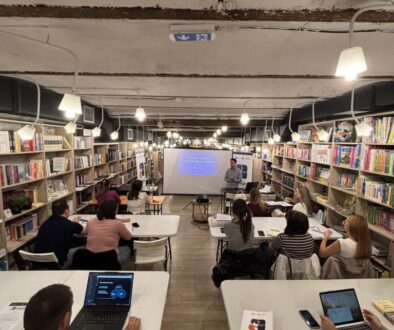
Ivan Ivanović and Suzana Trninić at the Third Youth Media Sprint Module: On Ethics, Trust and Journalism That Drives Change
The third module of “Youth Media Sprint: Novi Sad Newsroom Lab”, implemented by the Regional Academy for Democratic Development (ADD) in partnership with Educons University, took place on 17 October at Zenit Books in Novi Sad. The programme is supported through the regional project “MEdIA – Lit”, which aims to strengthen professional journalism, media literacy and democratic engagement across the Western Balkans.
This time, young journalists and media creators had the opportunity to engage in discussions with Ivan Ivanović and Suzana Trninić on journalistic ethics, professional responsibility, public trust in the media, and journalism that goes beyond identifying social problems to actively exploring potential solutions.

Ivan Ivanović: Journalism Begins with the Courage to Ask “Why”
The first part of the programme featured an exceptionally dynamic, open and thought-provoking discussion with Ivan Ivanović, one of the region’s most prominent television personalities, authors and presenters.
Reflecting on the current state of the media and professional standards, Ivanović warned of a profound crisis in journalistic ethics and highlighted its importance in a society where trust in institutions and public morality have been seriously undermined.
He recalled the words of journalist Gordana Suša, who believed that anyone unwilling to change the world should never have entered journalism in the first place. He also referred to a reflection by journalist Dragoljub Žarković, who argued that what distinguishes an outstanding journalist from others is the ability to answer not only the five fundamental questions of journalism, but also a sixth, and perhaps the most important one: why.

Ivanović devoted particular attention to the distinction between informing the public and pandering to audiences, as well as the challenges of preserving professional independence amid political, economic and commercial pressures.
He emphasised that journalistic ethics are not a matter of personal beliefs or feelings, but rather a responsibility to serve the public interest. Truthfulness, accuracy, independence, fairness and accountability, together with a clear distinction between facts, opinions and advertising content, form the foundations of the profession. Without these principles, journalism loses its very essence.
Although complete financial independence of the media is virtually impossible, he stressed that every journalist must establish their own boundaries when it comes to professional compromises and remain committed to fundamental ethical principles.
With his characteristic wit, sharp observations and numerous examples from his professional career, Ivanović encouraged participants to reflect on their own responsibilities, professional choices and the role journalists play in society.
Suzana Trninić: Journalism That Goes Beyond Identifying Problems to Explore Solutions
The second part of the programme offered a different, yet equally valuable perspective on the journalistic profession. Together with the brilliant Suzana Trninić, one of Serbia’s most experienced and respected journalists and editors, participants explored the possibilities offered by solution-based journalism.

At the heart of the workshop was the question of how journalism, without compromising its critical approach or its watchdog role in society, can take an important step forward: moving from identifying and investigating problems towards exploring responses, analysing existing solutions and understanding their real-world impact.
Drawing on decades of experience in television and investigative journalism, Trninić introduced young participants to the principles of this approach through concrete questions and practical methods of developing journalistic stories.

Particular emphasis was placed on distinguishing solutions journalism from positive news coverage and promotional content. Responsible journalism does not mean uncritically presenting success stories. Instead, it requires a thorough examination of what actually works, verification of evidence, recognition of limitations and consideration of whether particular approaches could be applied in other contexts.
During the practical part of the workshop, participants had the opportunity to examine their own story ideas through four essential elements of solutions journalism: responses to problems, evidence of results, limitations of proposed solutions and insights that others might apply.
Suzana’s sharp intellect, uncompromising commitment to facts, exceptional understanding of the profession and remarkable ability to turn complex issues into practical journalistic challenges made this session particularly valuable.
The workshop created space for reflection on how journalism can be both critical and constructive, rigorous and accessible, committed to the public interest while also contributing to positive social change.
A New Generation of Journalists Facing New Challenges
The third Youth Media Sprint module brought together two essential dimensions of contemporary journalism: an unwavering commitment to professional ethics and the responsibility to investigate social problems thoroughly while exploring possible responses and solutions.
The sessions with Ivan Ivanović and Suzana Trninić demonstrated how important it is for young journalists to engage directly with experienced professionals, challenge established approaches, exchange perspectives and develop their own professional integrity.
The future of quality journalism depends not only on new technologies and media formats, but above all on people who have the knowledge to understand society, the courage to ask difficult questions and the responsibility to seek answers in the public interest.
The Youth Media Sprint programme will continue with further activities aimed at strengthening professional skills, critical thinking and practical experience among young journalists and media creators.
About the Project
The project “Youth Media Sprint – Novi Sad Newsroom Lab”, implemented by the Regional Academy for Democratic Development (ADD) in partnership with Educons University, is supported through the broader “MEdIA – Lit” programme, led by the Centre for Civic Education (CCE/CGO) in partnership with the Helsinki Committee for Human Rights in Serbia, the Helsinki Committee for Human Rights in North Macedonia, the Tirana Centre for Journalistic Excellence in Albania, and the Atlantic Initiative in Bosnia and Herzegovina.
The programme is financially supported by the European Union and co-financed by the Ministry of Regional-Investment Development and Cooperation with Non-Governmental Organisations of the Government of Montenegro.
The Regional Academy for Democratic Development (ADD) is solely responsible for the content of this article, which does not necessarily reflect the views of the European Union, the Ministry, the Centre for Civic Education or the project partners.